Answer Engine Optimization (AEO): How to Get Cited by AI
AEO is the practice of structuring content so AI assistants cite you in their answers. Here's what answer engine optimization is, why it matters now, and a step-by-step playbook.

On this page
- What is answer engine optimization?
- Why AEO matters now
- How to do AEO, step by step
- 1. Lead with the answer (answer-first formatting)
- 2. Add structured data (FAQ, Article, Organization schema)
- 3. Cite statistics and real sources
- 4. Build topical authority with clusters
- 5. Keep content fresh
- 6. Publish an AI-readable knowledge layer (llms.txt and OKF)
- 7. Let AI crawlers in
- AEO vs traditional SEO
- Common mistakes
- Frequently asked questions
- What is answer engine optimization?
- Is AEO the same as GEO?
- Does AEO replace traditional SEO?
- How do I know if AI is citing my site?
- How long does AEO take to work?
- Conclusion
TL;DR — Answer engine optimization (AEO) is the practice of structuring content so AI assistants like ChatGPT, Perplexity, and Google's AI Overviews cite it in their answers. It's a focused part of AI search optimization: instead of only chasing a blue-link ranking, you make your content the source an answer engine pulls from.
- What it is: optimizing for AI-generated answers, not just search result pages.
- The shift: "getting cited" is replacing "getting ranked" for a growing share of queries.
- How: answer-first formatting, structured data, real sources, topical depth, and letting AI crawlers in.
What is answer engine optimization?
Answer engine optimization is the work of making your content the thing an AI answer engine quotes, summarizes, or links to when a user asks a question. An "answer engine" is any system that returns a synthesized response instead of a list of links — ChatGPT, Claude, Perplexity, Gemini, and the AI Overviews that now sit on top of Google results.
Traditional SEO asks: will Google rank this page? AEO asks a different question: when an AI assembles an answer, will it pull from this page and name the source? The mechanics overlap, but the target changed. You're optimizing for extraction and citation, not just position.
AEO vs GEO: the terms are often used interchangeably, and the practical playbook is nearly identical. "Generative engine optimization" (GEO) is the broader academic label for optimizing toward generative search systems. AEO is the more common, plain-language term for the same goal — being the answer. Throughout this guide, treat them as siblings: if you're doing AEO well, you're doing GEO.
Why AEO matters now
Search behavior is splitting in two. People still type queries into Google, but a fast-growing share now ask an AI assistant directly — and get a paragraph back instead of ten links. When the answer is synthesized, there's often no click at all. The "zero-click" pattern that started with featured snippets has accelerated: the assistant reads the sources and hands the user the conclusion.
That changes what winning looks like. Ranking #1 still matters, but it's no longer the whole game. If an AI Overview summarizes your topic and cites three competitors but not you, you lost the query even if your page is technically position one below the fold. The new objective is to be inside the answer — named, quoted, or linked as a source the model trusted.
This isn't speculative. AI assistants already attribute sources, and referrals from tools like ChatGPT and Perplexity are a real and growing channel for many sites. The exact share varies wildly by industry and is still small for most, so don't let anyone sell you a precise number. The durable point is directional: a slice of demand that used to flow through blue links now flows through answers, and that slice is growing. Building for it early is cheap insurance.
How to do AEO, step by step
AEO is less about tricks and more about being genuinely the clearest, most trustworthy source on a topic — then making that legible to machines. Here's the playbook.
1. Lead with the answer (answer-first formatting)
AI models extract self-contained statements. If the answer to a question is buried three paragraphs into a section, it's harder to lift cleanly. Put the direct answer in the first sentence or two under each heading, then expand. Use question-shaped H2s and H3s that mirror how people actually ask ("What is X?", "How do I do Y?"), and keep each answer tight enough to quote.
2. Add structured data (FAQ, Article, Organization schema)
Schema markup tells machines what your content is. Three types do the heavy lifting for AEO:
- FAQPage schema for question-and-answer blocks.
- Article schema for posts and guides, with author and date.
- Organization schema so engines know who you are and can attribute you confidently.
You don't have to hand-write JSON-LD. SEOAgent generates and maintains this schema directly in your codebase, alongside the metadata and FAQ blocks that feed it — so the structured layer stays in sync with the content.
3. Cite statistics and real sources
Answer engines favor content that looks evidence-backed: specific numbers, named studies, and outbound links to primary sources. Including credible data makes your page more quotable and more trustworthy to a model deciding what to cite. The flip side matters too — be accurate, because fabricated stats erode the trust that gets you cited in the first place.
4. Build topical authority with clusters
A single page rarely earns trust on its own. Models lean toward sources that cover a topic comprehensively. Build a hub-and-spoke cluster: a pillar page on the broad topic, plus focused sub-pages on every sub-question, all interlinked. Depth and internal linking signal that you're an authority on the subject, not a one-off.
5. Keep content fresh
Assistants prefer current information, especially for anything time-sensitive. Visible publish and update dates, and genuinely refreshed content, help an engine trust that your page reflects today and not three years ago. Stale content quietly loses citations to fresher competitors.
6. Publish an AI-readable knowledge layer (llms.txt and OKF)
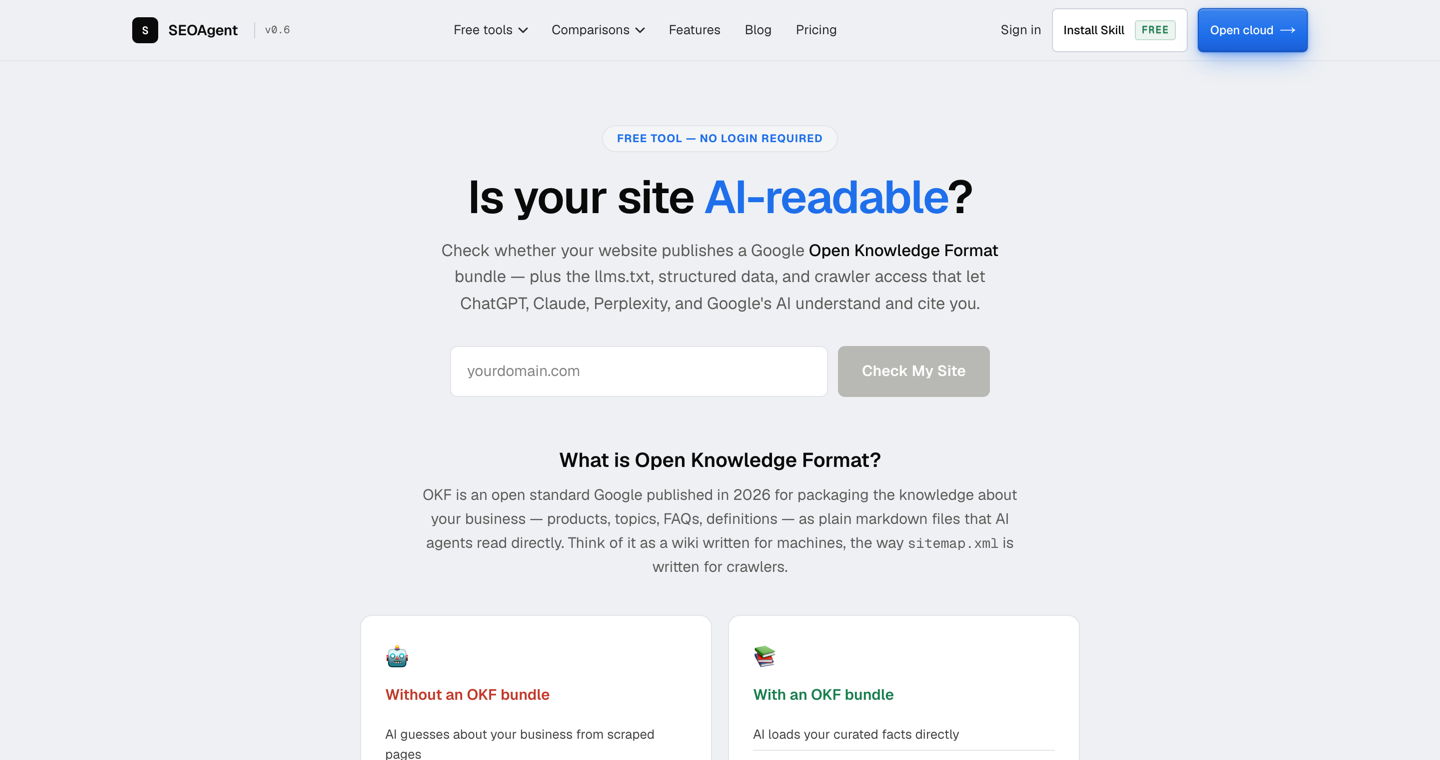
A newer practice: give AI crawlers a clean, machine-readable map of your site's key facts and pages. The emerging llms.txt convention is one approach — a plain-text file that points models at your most important content. The broader idea is an explicit knowledge layer so an assistant doesn't have to guess what your business is or which pages are canonical. You can see how your site currently looks to assistants with a free AI-readiness checker.
7. Let AI crawlers in
None of this works if the bots can't read you. Make sure your robots.txt doesn't block AI user agents like GPTBot, PerplexityBot, and Google-Extended (unless you have a deliberate reason to). Render important content server-side where possible — content that only appears after heavy client-side JavaScript is harder for some crawlers to ingest. If you want to be cited, you have to be readable.
AEO vs traditional SEO
AEO doesn't replace SEO — it extends it. Much of the foundation (clean technical health, good content, internal links) serves both. The difference is the target and the format.
| Dimension | Traditional SEO | Answer Engine Optimization |
|---|---|---|
| Goal | Rank in the result list | Be cited in the AI answer |
| Unit of success | Position (#1–#10) | Inclusion + attribution |
| Content shape | Comprehensive pages | Extractable, answer-first blocks |
| Key signals | Backlinks, keywords, CTR | Clarity, structure, sources, trust |
| Structured data | Helpful (rich results) | Central (machine attribution) |
| Crawlers | Googlebot, Bingbot | + GPTBot, PerplexityBot, Google-Extended |
| Click outcome | Click to your site | Often zero-click; brand/citation value |
The practical move is to do both at once. A well-structured, well-sourced, schema-rich page tends to rank and get cited.
Common mistakes
- Treating AEO as a separate project. It's an extension of good SEO, not a parallel rewrite. The same page can rank and get cited if it's structured right.
- Blocking AI crawlers by accident. A stray
robots.txtrule or aggressive bot-blocking can make you invisible to the exact engines you're trying to win. - Burying the answer. If a model has to dig for your point, it'll quote the competitor who stated it cleanly up top.
- Skipping schema. Without structured data, engines have to infer what your content is and who you are — and they infer wrong, or attribute someone else.
- Fabricating stats to look authoritative. Made-up numbers get caught, kill trust, and are exactly the kind of "AI slop" that gets sources dropped.
Frequently asked questions
What is answer engine optimization?
Answer engine optimization (AEO) is the practice of structuring and writing content so AI assistants — ChatGPT, Perplexity, Gemini, AI Overviews — cite it when generating answers. The goal is to be the source the model pulls from, not just to rank in a list of links.
Is AEO the same as GEO?
Effectively, yes. GEO (generative engine optimization) is the broader academic term and AEO is the more common plain-language one, but they describe the same goal: optimizing for AI-generated answers. The practical playbook is the same.
Does AEO replace traditional SEO?
No. AEO extends SEO. Technical health, quality content, and internal linking still matter and serve both. AEO adds an emphasis on answer-first formatting, structured data, credible sources, and letting AI crawlers in. For more on tools that help with both, see our roundup of the best AI SEO tools.
How do I know if AI is citing my site?
Some assistants show their sources inline, so you can ask them your target questions and check. You can also watch referral traffic from AI domains in analytics and use an AI-readiness checker to see how legible your site is to assistants in the first place.
How long does AEO take to work?
Like SEO, it compounds rather than flips a switch. Schema and answer-first formatting can be ingested within crawl cycles, but building the topical authority that earns consistent citations takes sustained, structured publishing over weeks to months.
Conclusion
Answer engine optimization is what SEO looks like when the search result is a generated answer instead of a list of links. The work rhymes with classic SEO — clarity, structure, trust, technical health — but the target moved: you're optimizing to be cited, not just ranked. Lead with the answer, add real schema and sources, build topical depth, keep it fresh, and let the AI crawlers read you. It's the natural next layer of AI search optimization, and the sites that build it now will own the answers later.
Put SEO on autopilot in your own editor
SEOAgent runs as a free skill inside Claude Code, Cursor, and Codex — on the model you already pay for. Audit, plan, and write SEO content right in your repo, with every change reviewed before it ships. No second AI subscription.
Get SEOAgent free