AI Search Optimization: The Complete Guide
AI search optimization is the practice of getting your content surfaced and cited by AI answer engines. Here's what it is, how it differs from SEO, and how to do it.

On this page
- What is AI search optimization?
- AI search optimization vs traditional SEO
- Why AI search optimization matters in 2026
- How AI answer engines choose what to cite
- The AI search optimization framework
- How to measure AI search visibility
- Content patterns that get cited
- Answer Engine Optimization (AEO)
- How to rank on ChatGPT
- A 30-day AI search optimization plan
- Common mistakes in AI search optimization
- Frequently asked questions
- What is AI search optimization?
- Is AI search optimization the same as SEO?
- What's the difference between AEO and GEO?
- How do I get cited by ChatGPT or Perplexity?
- Can I measure AI search visibility?
- Does AI search optimization require a developer?
- How is AI search optimization different from GEO?
- Will AI search replace traditional SEO?
- Conclusion
TL;DR — AI search optimization is the practice of structuring your site and content so AI answer engines — ChatGPT, Perplexity, Claude, Google's AI Overviews — can find, understand, and cite you when they answer a question. It overlaps with classic SEO (crawlable, fast, well-structured pages) but adds new priorities: answer-first content, machine-readable structure, and actually allowing the AI crawlers in.
- AI search is about being the cited source, not just the #1 blue link.
- The same clean technical foundations that rank well also get cited well — plus schema, freshness, and an AI-readable knowledge layer.
- The most common own-goal is blocking AI crawlers (GPTBot, ClaudeBot, PerplexityBot) by accident, so they can't cite you at all.
What is AI search optimization?
AI search optimization is the work of making your content discoverable and quotable by AI answer engines. When someone asks ChatGPT or Perplexity a question, the model assembles an answer and often cites a handful of sources. AI search optimization is everything you do to be one of those sources — from letting the crawlers reach your pages, to formatting answers they can lift cleanly, to publishing the structured signals that tell a machine what your content means.
It goes by a few names. Answer Engine Optimization (AEO) focuses on being the cited answer; Generative Engine Optimization (GEO) is the same idea framed around generative models. They're facets of the same goal: visibility in a world where a growing share of searches end with an AI-generated answer instead of a click. (For the deep dive on the citation mechanics, see Answer Engine Optimization (AEO): How to Get Cited by AI.)
AI search optimization vs traditional SEO
They share a foundation but optimize for different end states.
| Traditional SEO | AI search optimization | |
|---|---|---|
| Goal | Rank in the list of links | Be the cited source in an answer |
| Rewards | Backlinks, keywords, authority | Clear answers, structure, freshness, trust |
| Unit of success | A ranking position | A citation / mention |
| Key signals | Links, on-page relevance | Schema, answer-first copy, crawlability for AI bots |
| Measured by | Rankings, organic clicks | AI mentions, referral traffic from AI tools |
The overlap is large — crawlable, fast, well-structured, trustworthy pages win in both. But AI search adds a layer: a model has to be able to extract a clean, correct statement from your page and feel confident attributing it to you. That rewards clarity and structure over keyword density.
Why AI search optimization matters in 2026
Search behavior is splitting. People still Google, but they increasingly ask ChatGPT, Perplexity, and Claude directly — and Google itself now answers many queries with an AI Overview above the links. In all of those, the "result" is a synthesized answer that cites sources. If you're not among the cited sources, you're invisible to that entire surface, no matter where you rank in the traditional results.
Two things make this urgent rather than theoretical:
- AI referral traffic converts well. People who arrive from an AI assistant have usually already done their research inside the tool, so they tend to land with high intent. Even modest citation volume can punch above its weight.
- The field is young. The tactics aren't saturated, and the sites that build the right structure now — clean answers, schema, an AI-readable knowledge layer — establish themselves before the space gets crowded.
Because AI search optimization is largely technical and structural, it fits naturally into a codebase workflow. An SEO agent can audit your pages for the signals AI engines look for and propose the fixes for you to approve.
How AI answer engines choose what to cite
It helps to understand the rough pipeline a model runs before it cites you, because each stage is something you can influence.
- Retrieval. When a question needs current or specific information, the engine searches the web (or its index) for relevant pages. If your page isn't crawlable — or you've blocked the bot at the robots or firewall level — you never enter the candidate set. This is why crawler access is step zero: everything else is moot if you're not retrievable.
- Relevance. From the candidates, the model picks pages that actually answer the question being asked. Pages organized around clear questions and direct answers match far better than pages that bury the point under preamble or marketing.
- Extractability. The model needs to pull a clean, self-contained statement it can quote and attribute. A page with a crisp definition or a direct answer near the top is easy to extract; a vague, meandering one isn't, even if it's perfectly relevant. This is where most pages quietly lose.
- Trust and authority. Models weigh signals of expertise — topical depth, structured data, consistency with what other sources say, and recognizable authority on the subject. A site that covers a topic thoroughly reads as more trustworthy than one with a single thin post, so depth compounds.
- Freshness. For anything time-sensitive, recent and clearly-dated content wins. Perplexity and ChatGPT's browsing both favor up-to-date sources, so a visible "last updated" date plus an accurate
dateModifiedin schema both help.
Every tactic in this guide maps onto one of those stages: allow the crawlers (retrieval), write answer-first content and build clusters (relevance and extractability), add schema and depth (trust), and keep dates current (freshness). Optimize for the pipeline a model actually runs — not for a keyword.
The AI search optimization framework
Here's what actually moves the needle, roughly in order of impact.
- Let the AI crawlers in. This is step zero and the most common mistake. Check your
robots.txtand any WAF/firewall (Cloudflare, Vercel) — it's easy to block GPTBot, OAI-SearchBot, ChatGPT-User, ClaudeBot, and PerplexityBot by accident. If they can't fetch your pages, they can't cite you. Allow them explicitly if you want citations. - Lead with the answer. Put a direct, self-contained answer in the first 40–80 words of a page — a definition, a clear statement, a number. Models extract from the top of the page far more than the bottom, so bury the lede and you lose the citation.
- Add structured data.
FAQPage,Article,Organization, andHowToJSON-LD tell machines exactly what your content is and how it's organized. Schema is one of the strongest "this is a quotable, trustworthy source" signals you can send. - Build topical authority with clusters. AI models weight source specialization heavily. A hub-and-spoke cluster — a pillar plus supporting articles that link together — signals genuine expertise on a topic far more than a single isolated post.
- Keep it fresh. Visible "last updated" dates and an accurate
dateModifiedin your schema matter, especially for Perplexity and ChatGPT's browsing, which favor recent sources. Stale pages get passed over. - Cite real facts with sources. Statistics, comparisons, and clearly attributed claims are exactly the material an answer engine wants to quote. Make your content the easiest correct thing to cite.
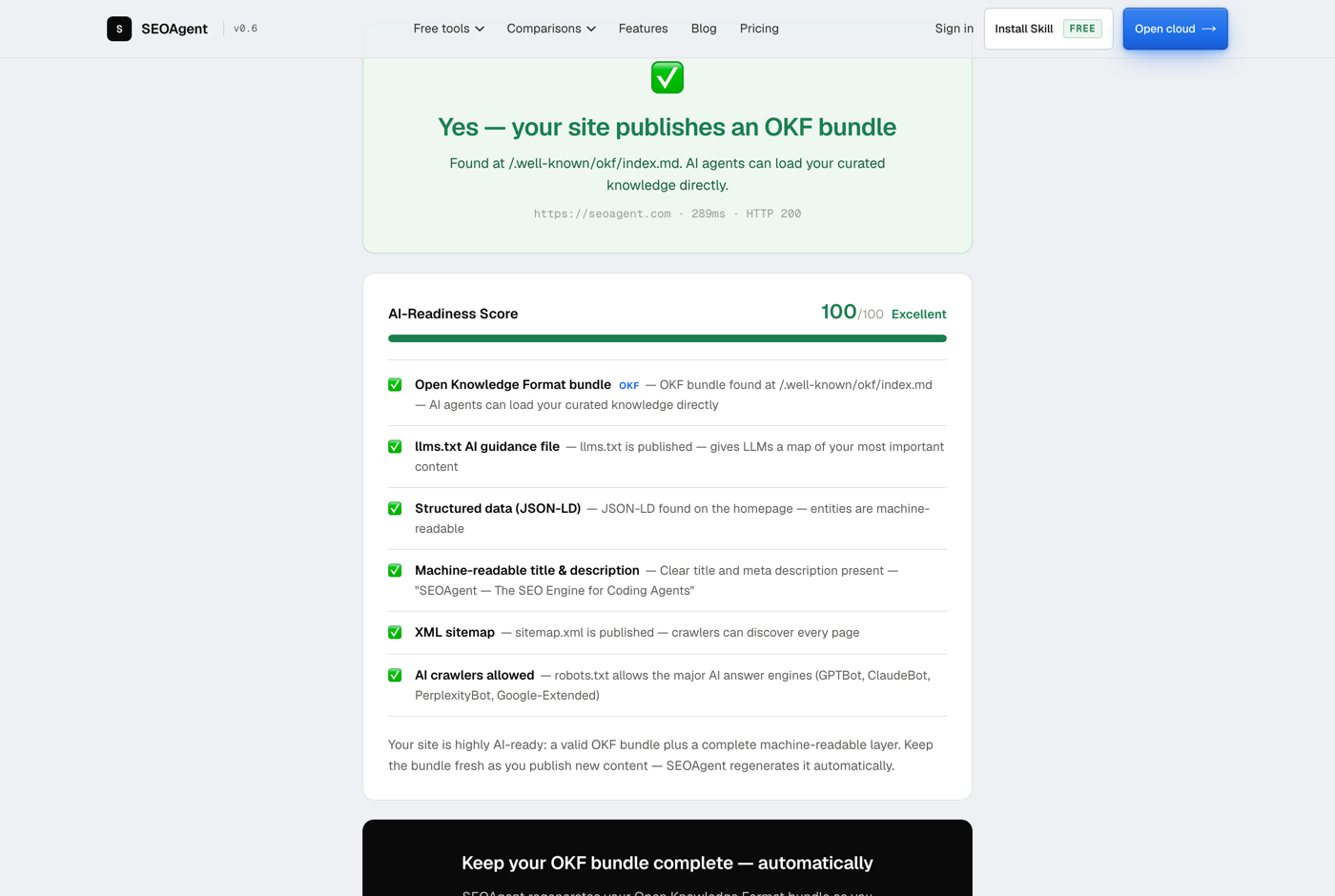
- Publish an AI-readable knowledge layer. Beyond per-page schema, you can publish a machine-readable bundle of your business's facts (an
llms.txtfile or an Open Knowledge Format bundle) so assistants can load and cite you accurately, wholesale. You can check how AI-ready your site is today with the AI-readiness checker.
Get #1 and #2 right and you've cleared the bar most sites never do. The rest compounds from there.
How to measure AI search visibility
AI search is harder to measure than rankings — but not impossible.
- Referral traffic from AI tools. Check analytics for sessions referred by
chatgpt.com,perplexity.ai, and similar. It undercounts (many AI answers never produce a click), but a rising trend is a real signal. - Tooling for the work itself. Structuring pages, writing the schema, and generating llms.txt is its own job — see AI search optimization tools.
- Spot-check the assistants. Ask ChatGPT, Perplexity, and Claude the buyer-intent questions your customers ask, and note whether you're cited. Repeat monthly to watch the trend. SEOAgent's citations checker automates a version of this — running queries through a model with live web search and reporting where you show up and where you're missing.
- Track mentions, not just links. AI engines often name a brand without a clickable link, so brand-mention monitoring catches visibility that referral analytics miss.
- Watch Search Console for AI Overviews. Google's AI Overviews draw heavily from organic results, so impressions and positions remain a useful proxy for that surface.
Treat all of these as directional. Precise per-engine attribution doesn't exist yet — so optimize the inputs (crawlability, answers, structure, freshness) and watch the trend rather than chasing one number.
Content patterns that get cited
Some formats are far easier for an answer engine to quote than others. Lean into:
- Definitions and direct answers. A clean "X is …" sentence is the single most citable thing on a page.
- Comparison tables. "X vs Y" tables are perfect extraction targets — AI Overviews love them.
- Numbered steps and checklists. Process content maps cleanly onto how assistants structure answers.
- FAQs. Natural-language questions with concise answers double as FAQ schema and ready-made answer snippets.
- Clear stats with sources. A specific, attributable number is exactly what a model wants to cite.
The through-line: write so a machine can lift one correct, self-contained statement and confidently attribute it to you. If a human can skim your page and quote it in a sentence, so can an AI.
Answer Engine Optimization (AEO)
AEO is the discipline of being the cited answer — the structural tactics (answer-first copy, FAQ and Article schema, topical depth) that make a model choose and attribute your page. It's the heart of AI search, and it's where most of the per-page work happens.
Read more → Answer Engine Optimization (AEO): How to Get Cited by AI
How to rank on ChatGPT
ChatGPT surfaces sources it can crawl and trust. Getting cited there is a mix of the fundamentals above plus being visible on the broader web ChatGPT already trusts — and, critically, not blocking its crawlers.
Read more → How to Rank on ChatGPT: A Practical Guide
A 30-day AI search optimization plan
Starting from zero, here's a realistic order of operations.
Week 1 — unblock and audit. Confirm AI crawlers aren't blocked in robots.txt or your firewall (this single check is the most common fix). Run your key pages through an AI-readiness check and fix anything that renders empty or lacks metadata.
Week 2 — structure your top pages. Rewrite the openings of your most important pages to lead with a direct answer. Add FAQ and Article schema. Make each page state clearly what it is and who it's for.
Week 3 — build depth. Pick one topic you have real authority on and publish (or interlink) a small cluster — a pillar plus a few supporting pages — so you read as a specialist, not a one-off.
Week 4 — publish a knowledge layer and measure. Add an llms.txt or Open Knowledge Format bundle so assistants can load your facts wholesale, then start tracking AI referral traffic and spot-checking the assistants so you have a baseline to improve against.
That's the same loop an SEO agent runs continuously — audit, fix, structure, measure — just done by hand the first time through.
Common mistakes in AI search optimization
- Blocking the crawlers. A "Block AI bots" toggle or a stray
Disallowquietly removes you from every AI answer. Check this first — it's the most common and most damaging mistake. - Writing for keywords, not answers. Keyword-stuffed copy with no clear, extractable statement gives a model nothing clean to quote.
- No structured data. Without schema, you're asking machines to guess what your page is. Don't make them guess.
- Thin, one-off content. A single post on a topic rarely reads as authoritative. Depth and internal linking signal expertise.
- Treating it as separate from SEO. AI search builds on technical SEO — uncrawlable or slow pages fail in both. They're one program, not two.
Frequently asked questions
What is AI search optimization?
It's the practice of structuring your site and content so AI answer engines (ChatGPT, Perplexity, Claude, Google AI Overviews) can find, understand, and cite you when they answer a question — the AI-era complement to traditional SEO.
Is AI search optimization the same as SEO?
It shares the same technical foundation but optimizes for a different outcome: being the cited source in an AI answer rather than a ranked link. The biggest additions are answer-first content, structured data, and explicitly allowing AI crawlers.
What's the difference between AEO and GEO?
Very little in practice. Answer Engine Optimization frames the goal as being the cited answer; Generative Engine Optimization frames it around generative models. Both describe optimizing to be surfaced by AI answer engines.
How do I get cited by ChatGPT or Perplexity?
Allow their crawlers, lead pages with clear answers, add FAQ and Article schema, build topical depth, and keep content fresh. See how to rank on ChatGPT for the step-by-step.
Can I measure AI search visibility?
Partly. You can track referral traffic from AI tools in analytics, run buyer-intent queries through the assistants to see whether you're cited, and use tools that probe answer engines for mentions. It's directional, not as precise as rank tracking — yet. How to run an AI search visibility check walks through the query set, the record to keep, and what to do with each finding.
Does AI search optimization require a developer?
The highest-impact pieces — crawler access, schema, render quality, an llms.txt/knowledge layer — are technical, so a developer (or an SEO agent working in the codebase) makes them much easier to get right.
How is AI search optimization different from GEO?
GEO (Generative Engine Optimization) is essentially another name for the same practice, emphasizing generative models. AI search optimization is the umbrella term covering AEO, GEO, and optimizing for AI Overviews — they all describe being surfaced by AI answer engines.
Will AI search replace traditional SEO?
No — it extends it. Traditional rankings still drive traffic and feed AI Overviews, and the technical foundations are shared. The smart move is one program that earns both rankings and citations, not two competing efforts.
Conclusion
AI search optimization isn't a separate channel bolted onto SEO — it's what SEO becomes as answers move from a list of links to a synthesized response with citations. Let the crawlers in, lead with clear answers, add structure, build depth, and stay fresh, and you put yourself in the set of sources AI engines actually quote. Because most of it is technical and structural, it belongs in your build-and-ship loop: the free SEOAgent Skill audits your pages for these signals and proposes the fixes, and the AI-readiness checker shows you where you stand today.
Put SEO on autopilot in your own editor
SEOAgent runs as a free skill inside Claude Code, Cursor, and Codex — on the model you already pay for. Audit, plan, and write SEO content right in your repo, with every change reviewed before it ships. No second AI subscription.
Get SEOAgent free