How to Rank on ChatGPT: A Practical Guide
ChatGPT cites pages it can crawl and trust. Here's the practical, step-by-step way to make your content show up — and the common mistakes that keep it invisible.

On this page
- How ChatGPT actually surfaces sources
- ChatGPT ranking factors
- How to rank in ChatGPT, step by step
- 1. Let OpenAI's crawlers in
- 2. Write answer-first content
- 3. Add FAQs and structured data
- 4. Build topical depth, not one-off posts
- 5. Keep content fresh
- 6. Get mentioned where ChatGPT already looks
- How to check whether you rank in ChatGPT
- Common mistakes
- Frequently asked questions
- How long does it take to start showing up in ChatGPT?
- What are the ChatGPT ranking factors?
- Is it "rank in ChatGPT" or "rank on ChatGPT"?
- Can I pay to rank on ChatGPT?
- Does ranking on Google help me rank on ChatGPT?
- How do I check whether ChatGPT can read my site?
- Do I need a separate tool for this, or is it just SEO?
- Conclusion
TL;DR — To rank on ChatGPT, make your pages easy to crawl and easy to trust. Let OpenAI's crawlers (GPTBot, OAI-SearchBot, ChatGPT-User) through your robots.txt and firewall, write answer-first content with clear definitions and FAQs, add structured data, build real topical depth, and earn mentions on sites ChatGPT already trusts. This is AI search optimization applied to one engine.
How ChatGPT actually surfaces sources
"Ranking" on ChatGPT isn't ranking in the Google sense — there's no fixed list of ten blue links. When ChatGPT answers a question that needs current information, it runs a search, reads a handful of pages, and synthesizes an answer, often with inline citations linking back to the sources it used. The goal is to be one of those cited sources.
Two things decide whether you make the cut: can ChatGPT reach your page, and does it trust what's on it.
Reachability comes down to crawlers. OpenAI uses a few distinct user agents, and they do different jobs:
| Crawler | What it does |
|---|---|
GPTBot |
Crawls pages to train and improve models |
OAI-SearchBot |
Discovers and indexes pages for ChatGPT search |
ChatGPT-User |
Fetches a page in real time when a user's prompt needs it |
If any of these is blocked — in your robots.txt, by a firewall rule, or by a bot-management product like Cloudflare's AI bot blocking — your page is effectively invisible to ChatGPT. OAI-SearchBot is the one that matters most for showing up in answers, so blocking it is the single fastest way to disappear. Being blocked isn't a ranking penalty; it's an on/off switch.
Trust is the harder half. ChatGPT favors pages that answer the question directly, are well-structured, and are corroborated elsewhere on the web. Much of what makes content extractable for AI overlaps with good SEO — but the emphasis shifts toward clarity and citation-worthiness over keyword density.
ChatGPT ranking factors
OpenAI publishes no ranking-factor list, so anyone who gives you one with weights is guessing. What you can observe is which pages get cited and what they have in common. Seven things show up consistently, and they are the factors the rest of this guide works through.
| Factor | What it means in practice |
|---|---|
| Crawler access | OAI-SearchBot and ChatGPT-User can fetch the page. Blocked means absent. |
| Server-rendered content | The answer is in the HTML the crawler receives, not injected by JavaScript afterward. |
| Answer-first structure | The first paragraph answers the question in a form a model can quote whole. |
| Clear hierarchy and schema | Headings match the questions people ask; Article and FAQPage JSON-LD label the parts. |
| Topical depth | The site covers the subject in a linked cluster, not a lone post. |
| Freshness | A recent dateModified and visible updates on time-sensitive pages. |
| Corroboration | Other sites ChatGPT already trusts say the same thing about you. |
The first two are binary. Fail either and the other five never get evaluated. That ordering is why the steps below start with crawlers and rendering rather than with content.
How to rank in ChatGPT, step by step
1. Let OpenAI's crawlers in
Start here, because nothing else matters if you're blocked. Check your robots.txt for Disallow rules targeting the user agents above, and confirm your CDN or firewall isn't silently dropping them. A permissive baseline looks like this:
User-agent: GPTBot
Allow: /

User-agent: OAI-SearchBot
Allow: /

User-agent: ChatGPT-User
Allow: /
If you want to allow ChatGPT search and real-time fetches but opt out of model training, allow OAI-SearchBot and ChatGPT-User while disallowing GPTBot. That's a legitimate choice — just know it's a tradeoff, not a free optimization.
2. Write answer-first content
Lead every page with the answer. Put a direct, self-contained response to the core question in the first paragraph — ideally something a model could lift verbatim and cite. Then expand. The inverted-pyramid structure that works for news works for AI extraction: conclusion first, supporting detail after.
Use the actual question as a heading where it fits, and keep paragraphs tight. Models extract cleanly from clear sentences, short paragraphs, and scannable lists far more reliably than from long, hedged prose.
Pair the answer with its evidence. A lead answer followed by a visible source — a linked URL and a date, right in the copy — gives the model both the quotable snippet and the provenance to trust it. The same claim floating unsourced gets cited less reliably, because ChatGPT corroborates before it quotes.
3. Add FAQs and structured data
Group the predictable follow-up questions into an FAQ section with real, specific answers — not filler. This gives ChatGPT discrete, quotable units that map directly to how people phrase prompts.
Back it with structured data. FAQPage, Article, and HowTo JSON-LD schema make the structure of your page machine-readable, which helps assistants parse what each section is for. Schema isn't a magic ranking lever, but it removes ambiguity, and ambiguity is what gets pages skipped.
4. Build topical depth, not one-off posts
ChatGPT tends to trust sites that demonstrably cover a subject, not sites with a single thin page on it. Build clusters: a pillar page on the broad topic, supporting pages on the specific sub-questions, all interlinked. Depth and internal linking signal genuine expertise — to AI engines and traditional search alike.
If you publish one post about a topic and nothing around it, you're a long shot. If you own the cluster, you're a likely citation.
5. Keep content fresh
ChatGPT's real-time search leans toward current information, especially for anything time-sensitive. Keep important pages updated, and surface that recency: set an accurate dateModified in your Article schema and reflect real edits in the visible content. A page last meaningfully touched two years ago competes poorly against one updated this quarter.
6. Get mentioned where ChatGPT already looks
This is the part you can't fake. ChatGPT corroborates claims across sources, so being referenced on sites it already trusts — reputable industry publications, well-moderated communities, established directories — raises the odds it treats your page as credible. Earn mentions the durable way: genuinely useful content, real relationships, and being quotable. Buying links or spamming forums does the opposite.
How to check whether you rank in ChatGPT
There is no rank tracker for ChatGPT in the Google sense, because there is no fixed results page to track. You measure it two ways, and they answer different questions.
Referrer data tells you what already happened. When ChatGPT sends a reader to your site, the session lands in GA4, PostHog, or your server logs with a chatgpt.com referrer. Group those sessions into a segment and watch the trend. The absolute number undercounts, because most answers are read without a click, but a rising line is real evidence.
Sampling tells you where you stand today. Ask the questions your buyers ask and record whether you are cited. The free seoagent citations command does this on your own model and writes a scorecard with trend and competitor share of voice to your repo. Paid vendors run the same idea on a schedule across several assistants. Both are directional: the answer depends on the prompt, the day, and the model version. The trade-offs between these approaches are in AI visibility tracking tools, ranked by trust.
Measure before and after you apply the steps above. If crawler access was the problem, the change is visible within days; if corroboration was the problem, expect months. Keep the records in one place while you do it: an AI search visibility checker sets out the fields to store per query and how to test Google AI Overviews and AI Mode alongside ChatGPT.
Common mistakes
- Blocking the crawlers by accident. A blanket
Disallowor an aggressive bot-management setting can wall offOAI-SearchBotwithout you ever noticing. Check first. - Burying the answer. A 400-word intro before you say anything useful gives a model nothing clean to cite.
- Chasing keyword density over clarity. AI engines extract meaning, not keyword counts. Write for a human; structure for a machine.
- Publishing thin, isolated pages with no surrounding cluster, then wondering why a deeper competitor gets cited instead.
- Treating it as set-and-forget. Freshness and corroboration decay. Citations follow maintained content.
Frequently asked questions
How long does it take to start showing up in ChatGPT?
There's no fixed timeline, and it varies by query and competition. Once crawlers can reach an updated page, OAI-SearchBot can index it for ChatGPT search relatively quickly — but earning citations also depends on trust signals that build over time. Getting the technical fundamentals right is the fastest lever you control.
What are the ChatGPT ranking factors?
The observable ones are crawler access, server-rendered content, answer-first structure, clear headings with schema, topical depth, freshness, and corroboration from sites ChatGPT already trusts. OpenAI has not published a weighted list, and there is no equivalent of PageRank to optimize against. Crawler access and rendering are prerequisites; the rest determine which reachable page gets quoted.
Is it "rank in ChatGPT" or "rank on ChatGPT"?
People say both, and they mean the same thing: being one of the sources ChatGPT cites when it answers a question. Neither phrase maps to a numbered position. A page is either quoted in the answer or it is not, and the same page can be quoted for one phrasing of a question and skipped for another.
Can I pay to rank on ChatGPT?
No. There's no paid placement in ChatGPT's organic answers. Visibility comes from being crawlable, trustworthy, and genuinely useful — the same earned-not-bought logic as classic SEO.
Does ranking on Google help me rank on ChatGPT?
Often, yes. The signals overlap heavily — crawlability, structure, authority, and topical depth all help in both places. But they're not identical: ChatGPT weights direct, extractable answers and corroboration more than raw backlink counts, so strong Google rankings help without guaranteeing citations.
How do I check whether ChatGPT can read my site?
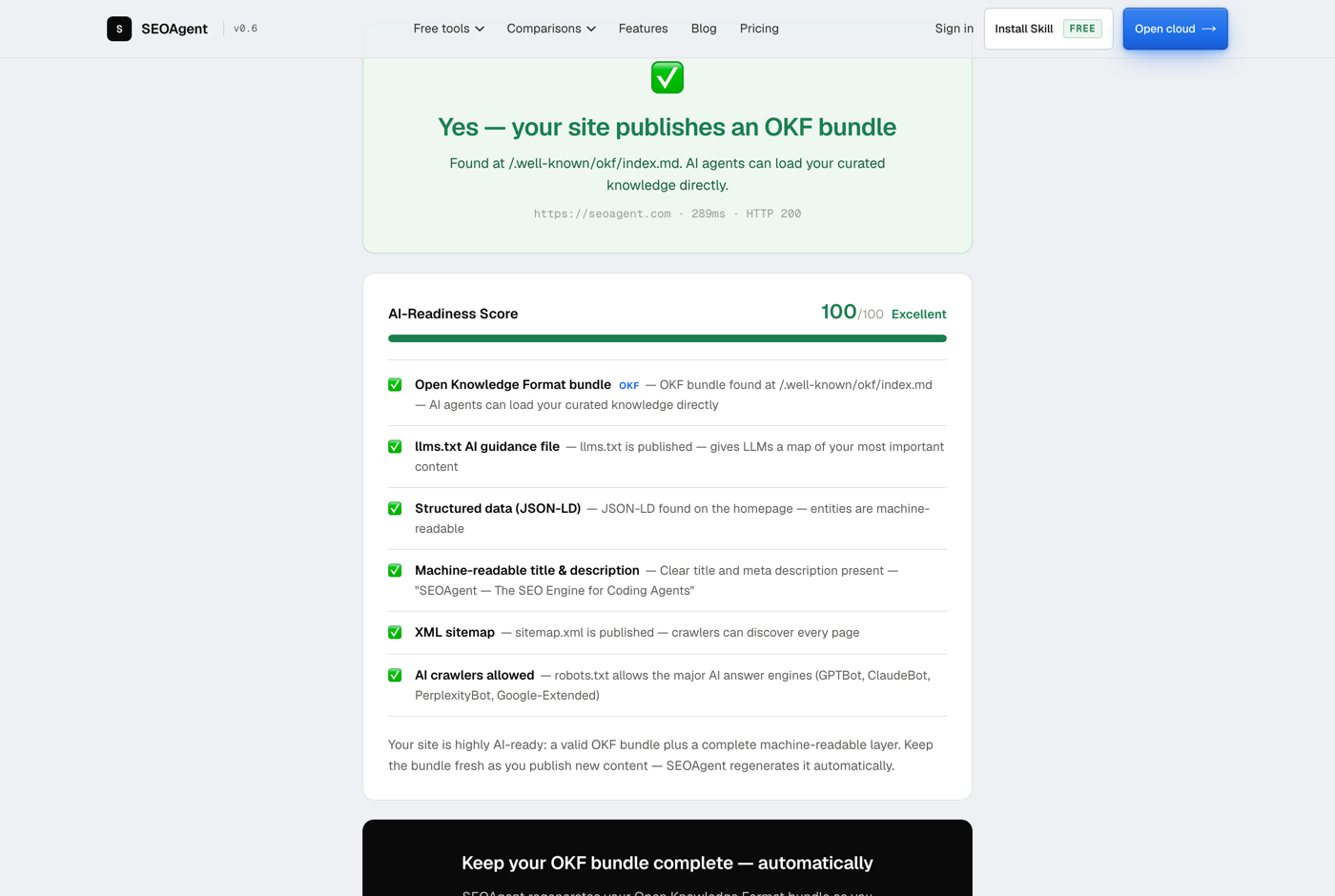
Confirm none of OpenAI's user agents are blocked in robots.txt or by your firewall, then verify your pages return clean, server-rendered HTML rather than content that only appears after JavaScript runs. You can check how AI-ready a page looks with an AI-readiness checker.
Do I need a separate tool for this, or is it just SEO?
It's mostly disciplined SEO with an AI emphasis: crawl access, answer-first writing, schema, and topical depth. Tooling helps you do it consistently. SEOAgent ships an Open Knowledge Format bundle and a citations checker to see how your content reads to assistants — useful, but the fundamentals above matter more than any single tool. If you want a deeper rundown of the category, see our guide to AI SEO tools.
Conclusion
Ranking on ChatGPT isn't a trick — it's making your best content reachable and trustworthy, then maintaining it. Let the crawlers in, answer the question in the first line, structure it with FAQs and schema, build real topical depth, and earn corroboration from sites ChatGPT already reads. That's AI search optimization in practice, and if you build your site in a codebase, an SEO agent can keep those fundamentals in place as you ship.
Put SEO on autopilot in your own editor
SEOAgent runs as a free skill inside Claude Code, Cursor, and Codex — on the model you already pay for. Audit, plan, and write SEO content right in your repo, with every change reviewed before it ships. No second AI subscription.
What do you use to work on your site?
Pick one above and we take you to the right setup.