SEO Agent: What It Is and the Best AI SEO Agents in 2026
An SEO agent is software that runs SEO work for you — technical fixes, research, and content. Here's what it does, how it differs from SEO tools and agencies, and how to choose the best AI SEO agent in 2026.

On this page
- What is an SEO agent?
- SEO agent vs SEO tool vs SEO agency
- Why SEO agents matter in 2026
- What a good SEO agent actually does
- What it's like to use an SEO agent
- SEO agents and AI search (AEO)
- The best AI SEO agents in 2026
- What an SEO agent still can't do
- Choosing an SEO agent for your stack
- Common mistakes when choosing an SEO agent
- How to get started with an SEO agent
- Frequently asked questions
- What is an SEO agent?
- How is an SEO agent different from an SEO tool?
- Are AI SEO agents better than an SEO agency?
- Do SEO agents help with AI search (ChatGPT, Perplexity)?
- How much does an SEO agent cost?
- Can an SEO agent work with my CMS or framework?
- Can an SEO agent hurt my SEO?
- Do I still need an SEO specialist if I use an SEO agent?
- How long does it take to see results from an SEO agent?
- Conclusion
TL;DR — An SEO agent is software that does the ongoing work of SEO for you: it audits your site, fixes technical issues, researches keywords and competitors, and builds or improves content. Modern AI SEO agents go further — they read your real Google Search Console data and propose evidence-backed changes. The best ones keep a human in the loop and work where your site already lives, instead of publishing AI slop on autopilot.
- An SEO agent automates SEO execution; an SEO tool only reports, and an SEO agency bills you to do it manually.
- AI SEO agents matter more in 2026 because search now includes AI answers (ChatGPT, Perplexity, Google AI Overviews), not just blue links.
- Choose an agent that grounds suggestions in your own performance data and lets you approve every change.
What is an SEO agent?
An SEO agent is software that carries out SEO work autonomously or semi-autonomously — technical fixes, on-page optimization, keyword and competitor research, and content creation — rather than just surfacing a list of problems for you to fix by hand. Where a traditional tool tells you "your title tags are too long," an SEO agent rewrites them. Where an agency schedules a call, an agent ships the change.
The "agent" part is the difference. An agent takes a goal ("grow organic traffic"), breaks it into tasks, and executes them — ideally checking its work against real data and pausing for your approval before anything goes live. The newest generation runs inside the tools developers already use, so SEO happens in your codebase instead of a separate dashboard you forget to open.
SEO agent vs SEO tool vs SEO agency
These three get conflated constantly. The short version: a tool measures, an agency does the work for a retainer, and an agent does the work as software.
| SEO tool | SEO agency | SEO agent | |
|---|---|---|---|
| What it does | Reports issues & metrics | Manual strategy & execution | Executes SEO as software |
| Who does the work | You | The agency | The agent (you approve) |
| Typical cost | $50–$200/mo | $2,000–$10,000+/mo | Free–$79/site/mo |
| Speed | Instant reports | Weeks of onboarding | Minutes to first fix |
| Best for | Analysts who like dashboards | Teams with budget, no time | Builders who ship from a codebase |
If you want to see how specific products line up, our head-to-head breakdowns cover the popular options — for example SEOAgent vs Surfer SEO and SEOAgent vs Jasper.
Why SEO agents matter in 2026
Search changed. People now get answers directly from ChatGPT, Perplexity, Claude, and Google's AI Overviews — often without clicking a single link. Ranking #1 isn't enough if the AI summarizing the page never cites you. At the same time, the bar for content quality went up: thin, generic AI articles get ignored by both readers and algorithms.
That combination rewards two things an SEO agent is good at: consistent technical hygiene (clean metadata, schema, internal links, fast pages) and steady, genuinely useful content built on real expertise. Doing both by hand is a part-time job most founders never get to. Doing it with an agent — grounded in your AI-readiness and Search Console data — is how small teams keep up.
There's also an economic shift. A few years ago, doing SEO well meant either learning a deep specialty or paying an agency thousands a month. An agent collapses that cost: the repetitive, mechanical 80% of SEO becomes software, and your time goes to the 20% that actually needs a human — positioning, voice, and which bets to make.
What a good SEO agent actually does
Not all "AI SEO" is equal. A capable SEO agent should cover the full loop, not just spit out articles:
- Audit — crawl the site and find technical issues: indexing, canonicals, missing metadata, broken internal links, slow pages.
- Fix — apply the safe, mechanical fixes itself (titles, meta descriptions, schema, alt text) and propose the rest.
- Research — pull keyword volume and difficulty, study competitors, and find the queries you can realistically win.
- Build — write landing pages and articles structured for both readers and AI answer engines, with automatic internal linking into a topic cluster.
- Measure & review — read your Google Search Console performance and suggest evidence-backed updates, so the work compounds instead of going stale.
The most important feature is the least flashy: a human approval step. An agent that auto-publishes unsupervised will eventually embarrass you. One that proposes changes you approve gives you leverage without losing control.
It's worth being precise about the word "automation" here. Plenty of tools automate reporting — they tell you what's wrong faster. An agent automates execution — it does the thing. That distinction is why an agent can replace hours of manual work that a dashboard never could: the dashboard hands you a to-do list, while the agent hands you a finished change to review. For where to draw that line, see what to safely automate and what to keep human.
What it's like to use an SEO agent
The best way to understand an SEO agent is to watch one work. In practice the loop looks like this:
- You install it where you work. For a codebase, that's a Skill in Claude Code, Cursor, or Codex (or a local CLI) — see the best SEO tools for Claude Code for how the options compare. For a CMS, it connects through the API your site already uses. There's no separate dashboard to babysit.
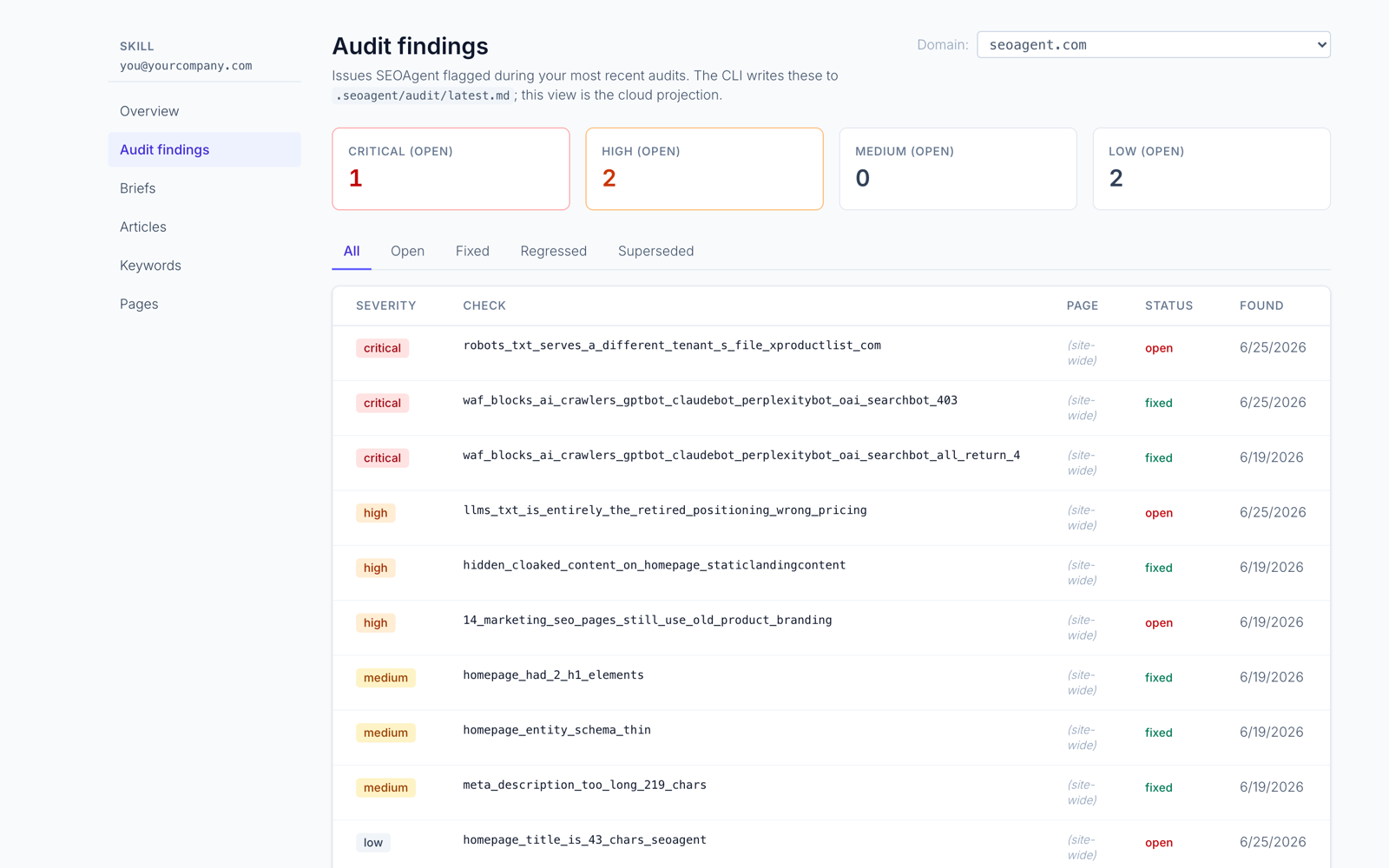
- It audits, then shows you what it found. Within minutes you get a prioritized list — a missing canonical here, three pages with no meta description, a cluster of orphan pages with no internal links. Each finding comes with the specific fix, not just the complaint.
- You approve, it ships. You skim the proposed change, approve what makes sense, and the agent writes it into your repo (or your CMS). Because it's a normal commit, the change is reviewable, revertible, and deploys through your existing pipeline.
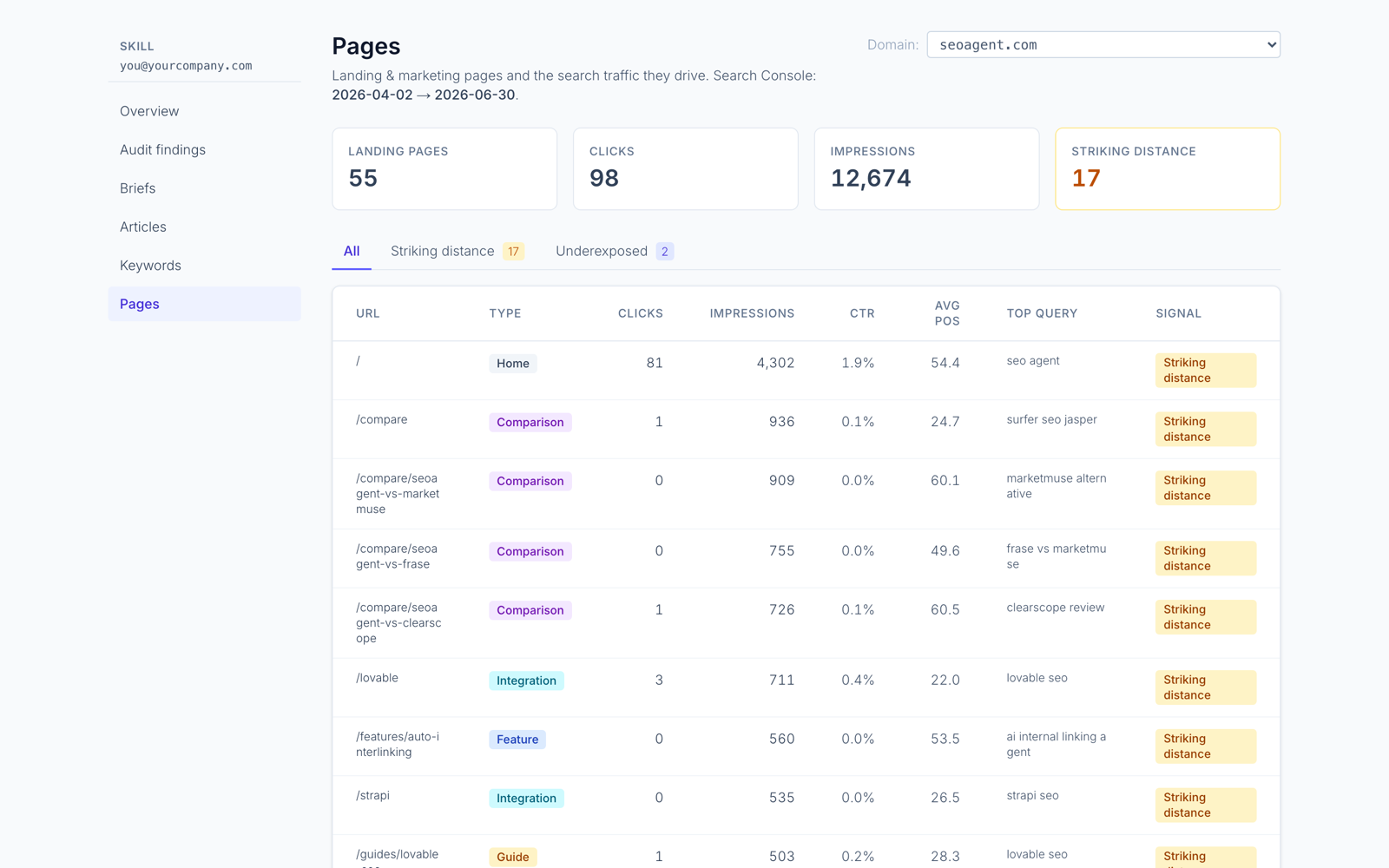
- It keeps watching. Once Search Console is connected, the agent stops guessing. It sees which pages are gaining or losing clicks, which queries you rank for on page two, and which articles have gone stale — and brings those back to you as concrete suggestions.
The shift is subtle but important: you're not "using an SEO tool" in a separate tab once a month. SEO becomes part of the same workflow you already use to build and ship your product.
What you actually check in that diff. Treat it like any other code review: product language and claims, URLs and canonical behaviour, schema validity, and whether the page still sounds like your company. Reject a keyword insertion that makes the copy worse — declining a suggestion is part of the workflow, not a failure of it.
A concrete example. Say a landing page describes "automated marketing" but the product serves developer teams building sites in Git. The agent might propose a more precise title, a paragraph about codebase changes, an internal link to SEO for SaaS sites, and an FAQ block. You can accept the metadata and the link, rewrite the paragraph in your own words, and decline the FAQ because the page has no genuine questions to answer. Four proposals, three outcomes, one commit.
SEO agents and AI search (AEO)
Traditional SEO optimizes for a ranked list of links. Answer Engine Optimization (AEO) — sometimes called Generative Engine Optimization — optimizes for being the source an AI assistant cites when it answers a question directly. As more searches end inside ChatGPT, Perplexity, Claude, and Google's AI Overviews, getting cited matters as much as ranking.
A capable SEO agent helps on both fronts, because the same structure that ranks well also extracts well:
- Answer-first formatting — a clear definition or direct answer in the opening paragraph, so an assistant can lift it cleanly.
- Structured data — FAQ, Article, and Organization schema that tell machines what a page is about.
- Topical depth — a hub-and-spoke cluster of related articles signals genuine expertise, which AI models weigh heavily.
- An AI-readable knowledge layer — some agents publish a machine-readable bundle (for example an
llms.txtor Open Knowledge Format file) so assistants can load a business's facts wholesale and cite them accurately.
If you want to see how your own site looks to answer engines today, run it through an AI-readiness checker before you start optimizing.
The best AI SEO agents in 2026
The category is young, so "best" depends on how you work. A few honest criteria to judge any AI SEO agent:
- Where it works — in your codebase/CMS, or a walled-off dashboard? In-codebase agents fit teams that ship their own site.
- What grounds its decisions — your real Search Console data and competitor research, or generic templates?
- Who's in control — does it auto-publish, or do you approve every change?
- What it costs to start — many tools are $89–$182/mo; a free local tier lets you try the full loop first.
It also helps to know the landscape. Most "AI SEO" products fall into a few buckets: content optimizers that score your writing against the SERP (Surfer, Clearscope), AI writers that draft copy across channels (Jasper), content-intelligence platforms that plan topics and briefs (Frase vs MarketMuse), all-in-one research and reporting suites that produce the metrics and the client report (Raven Tools vs Moz), and SEO agents that execute the work end to end. The first four are tools you operate; an agent is software that does the work and asks for your sign-off. Plenty of teams pair a writing or research tool with an agent that ships and maintains the result.
Here is how the named options land against those criteria. Only the first row is an agent in the strict sense — the rest are tools you drive, and they are on the list because they are what people actually shortlist against one.
| Tool | What it is | Where it works | Who approves changes | Best for |
|---|---|---|---|---|
| SEOAgent | Execution agent | Your repo, via Claude Code / Cursor / Codex | You, on every change | Teams who ship their site from version control |
| Surfer SEO | Content optimizer | Browser editor | You publish manually | Writers who want a live score while drafting |
| Clearscope | Content optimizer | Browser editor | You publish manually | Editorial teams who want a target, not a generator |
| Frase | Research + briefs + drafting | Browser app | You publish manually | Fast SERP research and brief building |
| MarketMuse | Content intelligence | Browser app | Planning only | Planning a content programme site-wide |
| Jasper | AI writer | Browser app | You publish manually | Multi-channel copy, not SEO specifically |
| Scalenut | Autopilot content | Browser app | Optional review | Keyword-to-draft in one pass |
Two honest caveats about a table like this. Pricing moves constantly, so check each vendor's current plans rather than a number in a blog post. And "agent" is doing a lot of marketing work across the category right now. Several products in the optimizer column have added an agent mode that still stops at handing you text. Apply one test. When it finishes, does a change exist on your site, or a document you still have to publish? For a category-by-category roundup of the tools half of this list, see the best AI SEO tools guide.
SEOAgent is built for the in-codebase, human-approved end of that spectrum: it ships as a free Skill for Claude Code, Cursor, and Codex (plus a local CLI) that builds and improves SEO pages directly in your repo, with an optional cloud layer that adds Search Console analysis and competitor research. You can start with the free Skill and add the cloud when you want measurement.
What an SEO agent still can't do
Worth knowing before you buy one, because the gaps are consistent across every product in the table:
- It can't decide your positioning. An agent will happily optimize a page for a keyword that brings the wrong buyers. Which topics are worth owning is a product decision, and it stays yours.
- It can't manufacture expertise you don't have. Agents assemble and structure what exists. Original research, customer stories, and opinions worth citing come from you.
- It can't earn links on its own. Off-page authority still runs on relationships and genuinely linkable work. Agents help by making the pages worth linking to.
- It can't fix a product nobody searches for. If there is no demand for the category, better metadata does not create it.
Choosing an SEO agent for your stack
The right fit depends on where your site lives. Headless and code-first stacks (Next.js, Vercel, Astro) pair naturally with an agent that edits real files; CMS-based sites want one that maps cleanly to their content model. SEOAgent takes the first route: the agent works in your repository and your own CI/CD ships the change, so there is no hosting or CMS integration to install. Role-specific guides cover the common shapes — SEO for SaaS and SEO for agencies.
A quick gut check: if a developer or a coding agent already touches your site, choose an agent that works in the codebase, where changes are versioned and reviewed. If a non-technical marketer owns the content and the site lives entirely in a CMS, choose one with a first-class integration for that CMS so posts land in the right content model without copy-paste. The wrong fit isn't catastrophic — but it adds a manual step to every article, which is exactly the friction an agent is supposed to remove.
Common mistakes when choosing an SEO agent
- Optimizing for volume over quality. An agent that publishes 90 thin articles a month can hurt more than it helps. Steady, substantive content wins.
- Letting it run fully unsupervised. Auto-publish with no review is how brands end up with off-message or inaccurate pages. Keep approval on.
- Ignoring AI search. If your pages aren't structured for answer engines (clear definitions, FAQs, schema), you're invisible to a growing slice of search.
- Buying on price alone. The cheapest tool that doesn't fit your stack costs more in wasted time than a free tier you can actually use.
How to get started with an SEO agent
You don't need a migration or a big commitment to try one:
- Run an audit first. Before changing anything, get an honest read on your technical SEO and AI-readiness. A free agent or audit tool will surface the quick wins — usually metadata, schema, and internal linking — without touching your site.
- Fix the cheap, high-impact issues. Approve the safe mechanical fixes. These often move the needle fastest because they unblock pages search engines were quietly ignoring.
- Connect Search Console. This is what turns guesswork into strategy. Once the agent can see real impressions and positions, it can prioritize the pages you're closest to winning.
- Build one cluster, not fifty one-offs. Pick a topic you have genuine authority on, and let the agent help you build a pillar plus a handful of supporting articles that link together. Depth beats volume.
The goal isn't to hand your brand to a robot. It's to take the repetitive 80% of SEO off your plate so the 20% that needs your judgment actually gets done.
Frequently asked questions
What is an SEO agent?
An SEO agent is software that performs SEO work for you — auditing your site, fixing technical issues, researching keywords, and building content — instead of only reporting problems like a traditional tool.
How is an SEO agent different from an SEO tool?
A tool measures and reports; you still do the work. An SEO agent executes the work as software and, in the best case, lets you approve each change before it ships.
Are AI SEO agents better than an SEO agency?
They serve different needs. Agencies bring senior human strategy at a high monthly cost; AI SEO agents deliver consistent execution at a fraction of the price. Many teams use an agent for the day-to-day and consult a specialist for strategy.
Do SEO agents help with AI search (ChatGPT, Perplexity)?
Good ones do. They structure content for answer engines — clear definitions, FAQs, and schema — and some publish an AI-readable knowledge bundle so assistants can cite you accurately.
How much does an SEO agent cost?
It ranges widely. Reporting tools run $50–$200/mo, agencies $2,000+/mo. SEOAgent's Skill is free and runs locally; its cloud tier is $79 per site per month.
Can an SEO agent work with my CMS or framework?
Yes — the better agents support both code-first stacks (Next.js, Vercel) and CMSs (WordPress, Shopify, Webflow, Ghost, Strapi). Pick one with a path for where your content actually lives.
Can an SEO agent hurt my SEO?
It can, if you let it run unsupervised and optimize for volume. Mass-published thin content, aggressive auto-changes to pages that already rank, or AI text with no real expertise behind it can all backfire. The safeguard is the same as the selling point: keep a human approving changes, and prioritize quality over quantity.
Do I still need an SEO specialist if I use an SEO agent?
For most small teams, an agent covers the day-to-day execution that used to eat hours: audits, fixes, internal linking, and steady content. A specialist still adds value for high-stakes strategy, competitive niches, and judgment calls — but you're paying them to think, not to hand-edit meta tags.
How long does it take to see results from an SEO agent?
Technical fixes (indexing, metadata, schema) can be picked up by search engines in days to weeks. New content and authority take longer — typically a few months — which is exactly why the consistency of an agent matters: it keeps shipping while you focus on the product.
Conclusion
An SEO agent turns SEO from a recurring chore into a background process: audit, fix, research, build, and review — on a loop, grounded in your real data, with you approving what ships. As AI answers reshape search, that consistency is what keeps small teams visible. If your site lives in a codebase, the lowest-friction way to try it is the free SEOAgent Skill — run your first audit in minutes, then decide what to publish.
Put SEO on autopilot in your own editor
SEOAgent runs as a free skill inside Claude Code, Cursor, and Codex — on the model you already pay for. Audit, plan, and write SEO content right in your repo, with every change reviewed before it ships. No second AI subscription.
What do you use to work on your site?
Pick one above and we take you to the right setup.