SEO Automation: What to Automate and What to Keep Human
Most of SEO is repetitive enough to automate — audits, meta tags, schema, internal links. Strategy, voice, and the decision to publish are not. Here's where the line sits.
On this page
- What is SEO automation?
- Why automate SEO?
- What you SHOULD automate
- What you should NOT fully automate
- How to automate SEO the right way
- Common mistakes
- Frequently asked questions
- What parts of SEO can be automated?
- Is SEO automation safe?
- Will automated SEO get me penalized by Google?
- Can SEO automation replace an SEO specialist?
- What's the difference between SEO automation and auto-blogging?
- Conclusion
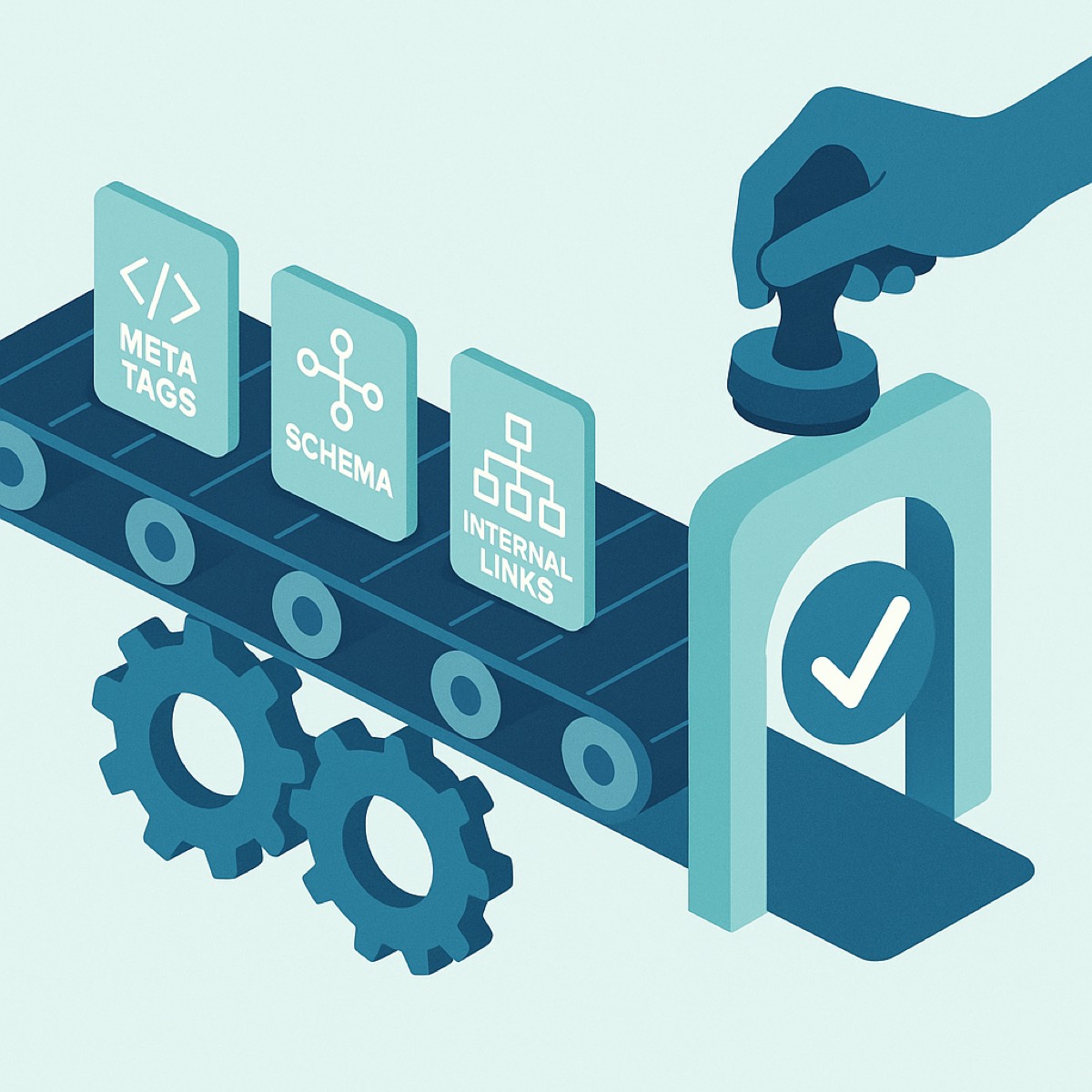
TL;DR — SEO automation works best when it handles the repetitive 80% — technical audits, meta tags, schema, internal links, sitemaps, alt text — while a human keeps the strategy, brand voice, fact-checking, and the final call on what ships. Automate the mechanics; review every change before it lands.
What is SEO automation?
SEO automation is using software to run the repetitive parts of search optimization — auditing pages, generating meta tags, adding structured data, fixing internal links, regenerating sitemaps — instead of doing each by hand. The point isn't to remove humans from the loop. It's to remove humans from the tedious loop so they spend time on the decisions that actually need judgment.
There's a sharp line worth drawing early, because it's where most of the confusion lives. On one side is automation that does the mechanical work and asks you to approve each change — the kind an SEO agent performs inside your codebase. On the other is auto-blog spam: tools that publish unreviewed AI content straight to your site on a schedule. Both get called "SEO automation." Only one is safe. This guide is about the first — and if you want the mechanics of the safe kind rather than the argument for it, see automated SEO optimization.
Why automate SEO?
SEO is mostly maintenance, and maintenance is mostly boring. A page needs a title tag, a meta description, clean schema, alt text on images, internal links pointing in and out, and a place in your sitemap. None of that is hard. It's just a lot of small, exacting tasks repeated across every page — and it has to stay correct as the site changes. That's the textbook shape of work a computer should own.
The second reason is consistency. SEO compounds: a page that ranks keeps earning traffic for months, but only if the technical foundation stays healthy and you keep shipping. A founder buried in product work doesn't get to that cadence by hand. Automation holds the line — re-auditing pages, catching the broken link you'd never notice, regenerating the sitemap when you add routes — so the compounding never stalls.
The third reason is that 2026 search rewards structure. AI Overviews, ChatGPT, and Perplexity pull answers directly from well-structured pages, so clean schema and tight on-page markup matter more than ever. Getting that right across a whole site is precisely the kind of repetitive, rules-based work automation is good at.
What you SHOULD automate
These are the tasks that are repetitive, rules-based, and verifiable — automate them without hesitation. A human should still glance at the diff, but the machine should do the work.
| Task | Why it's safe to automate |
|---|---|
| Technical SEO audits | Crawling for missing tags, broken links, and indexing issues is pure pattern-matching. |
| Meta titles & descriptions | Drafting and length-checking thousands of these by hand is wasted effort. |
| Schema / JSON-LD markup | Structured data follows a strict spec — ideal for generation and validation. |
| Internal linking | Finding orphaned pages and relevant link targets is graph analysis. |
| Sitemap generation | Should regenerate automatically whenever routes change. |
| Image alt text | Describing images at scale is a perfect job for a vision model. |
| Broken-link checks | Tedious to do manually, trivial to run on a schedule. |
| Re-audits over time | Drift happens; catching it should be continuous, not a quarterly project. |
The common thread: every item has a correct answer you can check. A schema block is valid or it isn't. A sitemap matches your routes or it doesn't. When the output is verifiable, automation is low-risk — and skipping it just means the work doesn't get done.
If your site lives in a codebase, this is even more clear-cut. See SEO for developers for how these fixes land as reviewable commits rather than opaque dashboard changes.
What you should NOT fully automate
The other 20% is where automation quietly becomes a liability. These tasks look automatable, but they carry judgment, risk, or both — keep a human in the loop:
- Strategy. Which topics to target, how to position against competitors, what to build next quarter. Software can surface keyword and Search Console data, but the call is yours. Buying for the longest feature list instead of your actual bottleneck is a strategy mistake no tool fixes.
- Brand voice. A model can draft, but it can't know that your audience hates buzzwords or that one competitor comparison is legally sensitive. Voice is a human signature.
- Fact-checking. AI confidently invents statistics, dates, and product details. Anything stated as fact needs a human to confirm before it's public — full stop.
- The decision to publish. This is the one that matters most. Generating a draft is cheap and safe. Pushing it live, unreviewed, is how brands end up with off-message, inaccurate, or embarrassing pages indexed under their name.
This is the exact difference between the two kinds of automation. "Automation with a human approving each change" means the software does the heavy lifting and you stay the editor-in-chief. "Auto-blog spam that publishes unreviewed AI content" hands the keys to the model and hopes for the best. The first compounds your authority. The second erodes it — and increasingly gets filtered out by search engines that can smell it.
SEOAgent is deliberately the first kind. The coding agent implements the change; only what you approve lands in the repo. There's no schedule quietly publishing on your behalf. For a category-by-category breakdown of what each kind of tool genuinely runs without you, see automated SEO tools.
How to automate SEO the right way
A sane setup looks like this:
- Automate the mechanics, gate the meaning. Let software run audits, generate tags, fix schema, and propose internal links. Keep a human approving anything that goes public.
- Keep changes reviewable. The best automation produces output you can inspect — a diff, a commit, a clear before/after — not silent edits to a live site. If you can't see what changed, you can't trust it.
- Make it evidence-backed. Good suggestions cite a reason: this page is orphaned, this title is over 60 characters, this competitor outranks you for this term. Suggestions without evidence are just noise.
- Stay local and version-controlled where you can. Changes that land as commits are revertible. Changes pushed straight to a CMS by a black box are not.
- Review, then scale. Validate the automation on a handful of real pages, confirm the output is good, then let it run across the site.
This is the model SEOAgent is built around. It's a free Skill for Claude Code, Cursor, and Codex — plus a local seoagent CLI — that audits your site and builds or improves SEO pages directly in your codebase. An optional cloud layer ($79/mo Pro) analyzes your Google Search Console data and researches competitors and keywords to produce evidence-backed suggestions you approve. Local-first, human-in-the-loop, and every change is a commit you can read. If you want the broader landscape, the best AI SEO tools guide compares the options by category, and the best SEO automation tools roundup covers the tools built specifically to automate the work.
Common mistakes
- Automating the decision to publish. Generating content is fine; auto-publishing it without review is the single fastest way to damage a brand and trip spam filters.
- Trusting output you can't inspect. If your tool edits a live site silently, you have no way to catch a bad change before it's indexed. Insist on reviewable diffs.
- Automating strategy. Tools surface data; they don't know your business. Outsourcing the what to build decision to software produces a generic site that ranks for nothing.
- Skipping fact-checking on AI drafts. Confident hallucinations are the default failure mode. Every factual claim needs a human pass before it ships.
- Treating "more pages" as the goal. Volume isn't SEO. A hundred thin auto-generated pages hurt you more than ten good ones help.
Frequently asked questions
What parts of SEO can be automated?
The repetitive, verifiable parts: technical audits, meta titles and descriptions, schema/JSON-LD, internal linking, sitemap generation, alt text, and broken-link checks. These have correct answers you can validate, which makes SEO automation low-risk for them.
Is SEO automation safe?
Yes — when a human approves changes before they go public. Automation that fixes technical issues and proposes edits for review is safe. Automation that publishes unreviewed AI content to your live site is not, and search engines increasingly penalize it.
Will automated SEO get me penalized by Google?
Automating technical fixes won't. Auto-publishing low-quality, unreviewed AI content can. The line Google cares about is whether the result is genuinely useful — automation that keeps a human editing toward usefulness stays on the right side of it.
Can SEO automation replace an SEO specialist?
It replaces most of the day-to-day execution — the audits, tag-writing, and schema work. A specialist still adds value for high-stakes strategy and competitive positioning. You're paying them to think, not to hand-edit meta tags.
What's the difference between SEO automation and auto-blogging?
SEO automation does mechanical work and asks you to approve each change. Auto-blogging publishes AI content to your site on a schedule with no review. The first keeps you in control and builds authority; the second risks your brand and your rankings.
Conclusion
SEO automation isn't all-or-nothing — and that's the whole point. The repetitive 80% should run as software: audits, meta tags, schema, internal links, sitemaps, alt text, re-audits. The judgment-heavy 20% — strategy, voice, fact-checking, and the decision to publish — should stay with a human. Get that split right and automation compounds your work instead of putting your brand at risk. If your site lives in a codebase and you want execution you can actually review, an SEO agent that proposes changes for your approval is the safest place to start. Try the free Skill, validate it on a few real pages, and scale from there.
Put SEO on autopilot in your own editor
SEOAgent runs as a free skill inside Claude Code, Cursor, and Codex — on the model you already pay for. Audit, plan, and write SEO content right in your repo, with every change reviewed before it ships. No second AI subscription.
What do you use to work on your site?
Pick one above and we take you to the right setup.