Programmatic SEO: A Practical Guide
Programmatic SEO turns a dataset and one strong template into hundreds of useful pages. Done right it scales authority; done wrong it ships thin pages Google ignores. Here's the practical version.
On this page
- What is programmatic SEO?
- Why it works — and when it backfires
- How to do programmatic SEO step by step
- 1. Find a scalable dataset and keyword pattern
- 2. Design ONE strong template
- 3. Generate pages from data
- 4. Ensure unique value per page
- 5. Internal linking and discovery
- 6. Sitemap and indexing
- Common mistakes
- Frequently asked questions
- Is programmatic SEO against Google's guidelines?
- How many pages should I generate?
- What's a good dataset for programmatic SEO?
- How do I keep programmatic pages from being thin?
- Do I need to be a developer to do programmatic SEO?
TL;DR — Programmatic SEO generates many pages from one template plus a structured dataset — one page per city, integration, comparison, or use case. It works when each page answers a real query with genuinely unique value, and it backfires into thin, spammy pages when it doesn't.
- Best for repeatable query patterns at scale ("X in [city]", "[A] vs [B]")
- Needs a real dataset, one strong template, and unique value per page
- Done right, it's the opposite of AI slop — structured pages built on real data
- Done wrong, you ship hundreds of near-duplicate pages Google quietly ignores
Programmatic SEO is one of the highest-leverage tactics a developer can run, because the work lives where you already work: in code, against data, in version control. If you build your site in a codebase, this is a natural extension of SEO for developers — you template once and let data do the rest.
What is programmatic SEO?
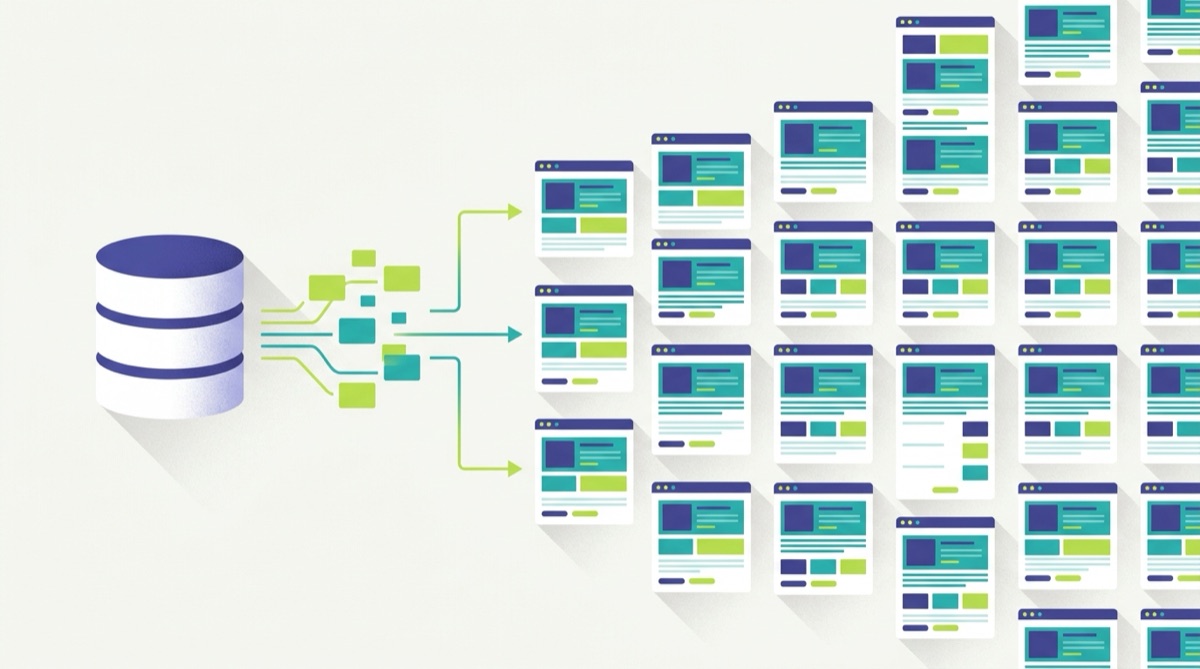
Programmatic SEO (sometimes "pSEO") is the practice of generating a large set of pages from a single template and a structured dataset, instead of hand-writing each page. You design one page layout, point it at rows of data, and produce one URL per row.
The classic examples are everywhere once you notice them. Zapier's "[App A] + [App B] integrations" pages, Tripadvisor's "things to do in [city]" pages, and G2's "[category] software" pages are all one template filled by a database. Each page targets a specific long-tail query that would never be worth writing by hand, but together they capture enormous search demand.
The mechanics are simple:
- A keyword pattern — a repeatable search like "best [cuisine] restaurants in [city]" or "[tool] alternatives".
- A dataset — the rows that fill the variables (cities, tools, categories, metrics).
- A template — one well-designed page that renders any row.
Multiply the dataset by the template and you get the page count. The skill is making each of those pages worth visiting.
Why it works — and when it backfires
Programmatic SEO works because search demand has a long tail. Most searches are specific and low-volume individually, but there are millions of them. No team can hand-write a page for "shopify apps for subscription billing" and "shopify apps for wholesale" and a thousand other variants. A template can. You capture demand that competitors writing one article at a time will never reach.
It also compounds. Once the template and pipeline exist, adding 200 more pages is a data change, not a writing project. That's the same leverage a developer gets from a good abstraction.
Here's where it backfires. If your template produces pages that are 90% identical boilerplate with one swapped word, you've built thin content — and Google's been explicit that "scaled content abuse" (mass-producing pages that add little value, whether by automation or templates) is a spam policy violation. The symptom is pages that get crawled, maybe indexed for a week, then dropped. You did the engineering work and got nothing, or worse, dragged down the rest of the site's quality signals.
The dividing line is unique value per page. A programmatic page about "project management software for agencies" must actually contain information specific to agencies — not the generic project-management blurb with "for agencies" pasted into the H1. This is exactly the trap the AI-slop crowd falls into: volume with no substance. Programmatic SEO done right is the opposite — structured, data-backed pages that genuinely answer a query. SEOAgent leans hard on that distinction: pages should be built on real data and real expertise, reviewed before they ship, not auto-spammed.
| Programmatic SEO done right | Thin-content trap | |
|---|---|---|
| Data per page | Real, distinct values | One swapped word |
| Template | One strong, useful layout | Boilerplate with a variable |
| Intent match | Each page answers a real query | Pages chase keywords, not questions |
| Review | Spot-checked before shipping | Auto-published, never read |
| Outcome | Compounding long-tail traffic | Crawled, dropped, ignored |
How to do programmatic SEO step by step
1. Find a scalable dataset and keyword pattern
Start from a query pattern with real, repeatable demand. Good signals: a [modifier] + [entity] structure, dozens-to-thousands of possible values, and searchers with clear intent. Validate that people actually search the pattern — check a keyword tool, autocomplete, or your own Search Console for queries you already rank for accidentally.
Then make sure you have (or can build) the dataset that fills it. The dataset is the moat. Anyone can template; not everyone has proprietary numbers, a curated list, or structured data competitors lack. If you can only fill the template with generic filler, stop — that's the thin-content path.
2. Design ONE strong template
Build a single page template that would be genuinely useful even for one row. Treat it like a real landing page: a clear H1 with the variable, a concise intro that states the answer, the data rendered as a table or list, supporting context, and a relevant CTA. Add per-page structured data (schema) so the pages are eligible for rich results.
Nail this one page before you generate 500. Every flaw multiplies.
3. Generate pages from data
Render the template across your dataset. In a modern stack this is straightforward — Next.js generateStaticParams, Astro's getStaticPaths, or any framework's dynamic-route-plus-data-fetch pattern. (For the Next.js specifics, see the Next.js SEO guide.) The output should be static, fast, crawlable HTML — not pages that need JavaScript to show their content. Whatever host you deploy to, the SEO layer belongs in the same build — generated pages that only exist behind a proxy fall out of sync with the data that produced them.
4. Ensure unique value per page
This is the step that separates ranking from ignored. For each page, ask: does this contain information a searcher can't get from the others? Pull in real metrics, page-specific examples, distinct comparisons, local details — whatever your dataset makes genuinely different. Vary the supporting copy where it matters, not just the variable. If two pages would read 95% the same, either enrich the data or merge them.
5. Internal linking and discovery
Programmatic pages are orphans by default — nothing links to them, so nothing gets crawled. Build the link graph deliberately: hub pages that list and link to the set, "related" links between sibling pages (city → nearby cities, tool → alternatives), and links from your high-authority editorial pages into the relevant cluster. Internal links are how authority flows to the long tail.
6. Sitemap and indexing
Add every programmatic URL to your XML sitemap and submit it in Search Console so Google can discover the set efficiently. Then watch indexing. If you generate 1,000 pages and Google indexes 80, that's the signal that the other 920 read as thin — fix value or prune, don't just resubmit.
Common mistakes
- No dataset, just keyword permutations. Spinning "[keyword] in [city]" with identical body copy is the textbook scaled-content violation. Data first, pages second.
- Shipping before the template is great. A mediocre template times a thousand is a thousand mediocre pages. Perfect one row first.
- Leaving pages orphaned. No internal links means no crawling means no rankings, no matter how good the pages are.
- Ignoring indexing signals. Index coverage in Search Console tells you exactly which pages Google rejected as low-value. Read it.
- Auto-publishing with no review. Generation should be automated; judgment shouldn't be. Spot-check output before it ships. This is the line between a useful page set and AI slop. Tools like SEOAgent keep the human in the loop on purpose — the agent builds, you approve.
- Targeting queries you can't satisfy. If a searcher wants a thing your page doesn't have, no amount of templating saves it.
Frequently asked questions
Is programmatic SEO against Google's guidelines?
No — generating pages from data is fine. What violates policy is "scaled content abuse": mass-producing pages that add little or no value. The technique is neutral; the value per page is what Google judges.
How many pages should I generate?
As many as you have real, distinct data for — and no more. If the dataset supports 300 genuinely useful pages, build 300. Padding to 3,000 with thin variants hurts the whole site. Quality of each page beats raw count.
What's a good dataset for programmatic SEO?
Anything structured, distinct per row, and tied to search demand: locations, integrations, comparisons, use cases, job titles, product specs, or proprietary metrics. The best datasets are ones competitors don't have. If you can only fill the template with generic text, you don't have a dataset yet.
How do I keep programmatic pages from being thin?
Lead with data, not prose. Each page needs information specific to its row — real numbers, examples, or comparisons — plus a template useful enough to stand alone. Then check Search Console indexing and prune anything Google won't index.
Do I need to be a developer to do programmatic SEO?
It helps a lot, because the work is templating and data wrangling. If your site lives in a codebase, programmatic SEO fits naturally into your workflow — see SEO for developers for the broader picture, the best AI SEO tools for what can help, and the AI-readiness checker to confirm your generated pages are extractable by search and AI engines.
Put SEO on autopilot in your own editor
SEOAgent runs as a free skill inside Claude Code, Cursor, and Codex — on the model you already pay for. Audit, plan, and write SEO content right in your repo, with every change reviewed before it ships. No second AI subscription.
Get SEOAgent free