How Artificial Analysis Grew Its Google Traffic 3.5× in a Year: An SEO Teardown
An SEO teardown of artificialanalysis.ai: the leaderboard and comparison pages that carry its search traffic, why they keep ranking, and what a founder can copy this week. Traffic figures are DataForSEO estimates.
On this page
- TL;DR
- The numbers, month by month
- Where the visits land
- What Artificial Analysis built: the page people come back to
- 1. One page that answers a question people keep asking
- 2. Answers written from the data, in text
- 3. Structured data that says "this is a dataset"
- 4. A page for each model, ready on launch day
- 5. Internal links everywhere
- What carried less
- The URL check
- What you can copy this week
- What to watch out for
- Why this takes a strategy that keeps running
- Sources
TL;DR
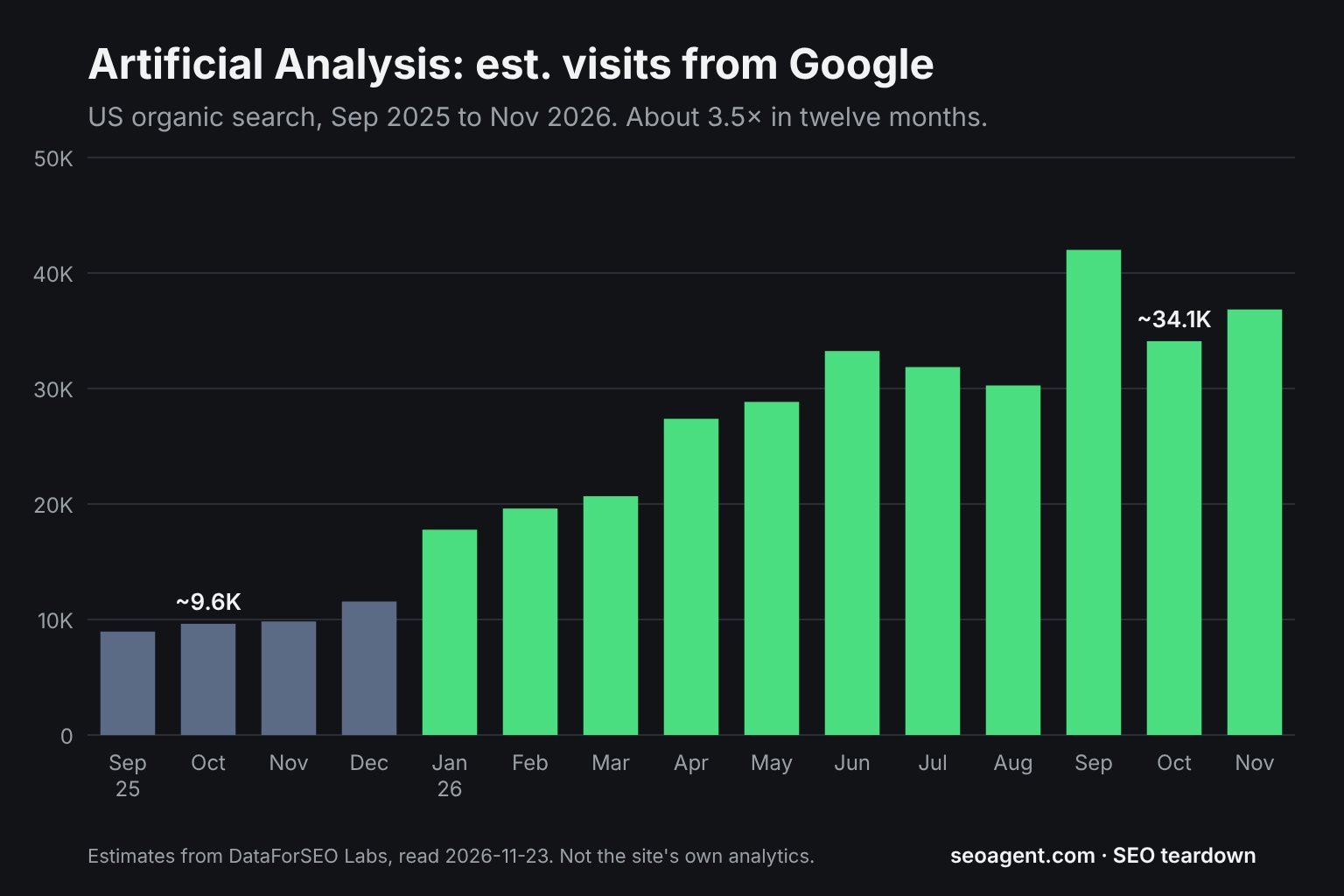
- Artificial Analysis, which benchmarks AI models and API providers, went from about 9,600 to about 34,100 estimated monthly visits from US Google search between October 2025 and October 2026. Every traffic number here is a DataForSEO estimate, not the site's own analytics.
- It now ranks for fewer searches than it did in January (about 7,200, down from 15,100), but it holds #1 for more of them: 477 in October 2026, up from 136 a year earlier.
- Two data pages, the LLM leaderboard and the model comparison page, get about 47% of the estimated traffic. With the home page, three pages get about 82%.
- Those pages answer searches people make again and again ("llm rankings", "ai benchmarks", "best ai models"), and their answers change whenever the data changes, so the page stays the current answer.
- About 1,600 model-vs-model comparison pages, generated from the same data, don't appear among the site's 40 pages with the most search traffic.
Each teardown on this blog picks a public site whose estimated search traffic grew at least 3× in a year and reads what it built. For artificialanalysis.ai we used DataForSEO Labs (US Google, English, read on 2026-11-23), SEOAgent's free URL check, and the pages themselves. We have no access to the site's analytics, so treat every visit figure as an estimate that can be off in either direction. The shape of the curve and the split between pages are more reliable than any single number.
The numbers, month by month
| Month | Estimated visits from Google | Searches it ranks for | Searches at #1 |
|---|---|---|---|
| Oct 2025 | ~9,600 | ~9,800 | 136 |
| Jan 2026 | ~17,800 | ~15,100 | 196 |
| Apr 2026 | ~27,400 | ~10,300 | 340 |
| Jun 2026 | ~33,200 | ~9,000 | 387 |
| Sep 2026 | ~42,000 | ~6,900 | 425 |
| Oct 2026 | ~34,100 | ~7,200 | 477 |
| Nov 2026 (latest reading) | ~36,800 | ~7,000 | 457 |
Source: DataForSEO Labs historical_rank_overview, United States.
The estimate climbed most months from late 2025 and jumped in January and April 2026. Over the same stretch, the number of searches the site ranks for peaked in January and then fell by more than half. The count at #1 kept rising.
For a founder, that pattern is the useful part. The site didn't grow by showing up for more searches. It grew by becoming the top answer for a smaller set of searches that many people type.
Where the visits land
| Page | Estimated visits a month | Searches it ranks for | At #1 |
|---|---|---|---|
| Home page | ~12,500 | 346 | 24 |
| /leaderboards/models | ~9,300 | 345 | 128 |
| /models | ~7,900 | 194 | 84 |
| /evaluations/artificial-analysis-intelligence-index | ~640 | 16 | 4 |
| /agents/chatbots | ~550 | 488 | 3 |
Source: DataForSEO Labs relevant_pages, United States, read 2026-11-23.
The home page's traffic is mostly people who already know the name. Searches for "artificial analysis" and its variants bring about 29% of the traffic from the site's top 100 keywords, and nearly all of it lands on the home page.
The two data pages bring the strangers. In DataForSEO's US data, the leaderboard ranks #1 for "llm rankings", "ai rankings" (about 4,400 searches a month each), "llm leaderboards" (about 8,100) and "best ai models" (about 4,400). The comparison page at /models ranks #1 for "ai models" (about 22,200) and "ai benchmarks" (about 8,100). People typing those want a current answer to "which model is best right now?" and may never have heard of Artificial Analysis.
What Artificial Analysis built: the page people come back to
1. One page that answers a question people keep asking
"Which AI model is best?" has a different answer every few weeks. The leaderboard is a single page with one table of every model the site tests, sortable by intelligence, price and speed. Its title says what it is in the words people search: "LLM Leaderboard - Comparison of AI models from OpenAI, Anthropic, Google, Meta & others".
Because the question never stops changing, the searches never stop either. A page that holds the current answer earns those searches every month.
2. Answers written from the data, in text
Below the table, the leaderboard has a "Frequently Asked Questions" section with nine questions, such as "Which AI model ranks #1 on the LLM Leaderboard?" and "Which is the fastest AI model?". Each answer is one plain sentence with the current names and numbers, for example how many models are ranked and which one leads. The page marks the questions up as FAQPage structured data.
The answers are written from the same data as the table, so when a new model takes the top spot, the sentence changes too. A table alone is hard for a search engine or an AI answer to quote. A sentence like "X currently ranks #1, out of N models ranked" is easy to quote, and it is never stale.
3. Structured data that says "this is a dataset"
The home page and /models carry Dataset structured data for their charts, naming Artificial Analysis as the creator. It tells search engines the page holds measured data with a publisher behind it.
4. A page for each model, ready on launch day
When a new model comes out, people search "[model] benchmarks". The site has a page per model with the same sections each time (intelligence, cost, speed, context window, and a FAQ). In the latest reading, its GLM-5.2 page ranks #1 for "glm 5.2 benchmarks". Six single-model pages appear among the site's top 40 pages, with about 800 estimated visits a month between them. Each one is small, but each catches a launch-week spike the main leaderboard can't.
5. Internal links everywhere
The leaderboard links to about 430 different pages on the site, from model pages to evaluations and providers. Every model in the table is a link to its own page, and every model page links back.
What carried less
The site's main sitemap lists over 3,000 URLs. About 1,600 of them are model-vs-model comparison pages ("[model A] vs [model B]"), generated for many pairs. None of them appears among the 40 pages with the most estimated search traffic. The site's 148 articles also bring little from Google; the best one in the top 40 gets about 90 visits a month.
Generated comparison pages are a common SEO project because the data is already there. On this site, almost all the traffic goes to two hand-built pages that summarize all the data at once.
The URL check
We ran SEOAgent's URL check (the same one behind the free SEO doctor) on artificialanalysis.ai on 2026-11-23. It read 8 pages. Nothing blocks Google: the home page loads and can be indexed, canonical tags point at the site itself, the content is in the HTML, robots.txt lets Google in, there is an XML sitemap, and http and www redirect to one address. The site runs on Next.js and is built from a code repository.
It found three smaller things worth fixing: no Organization structured data on the home page, 3 of 8 pages with a missing or off-length meta description, and 1 of 8 pages without an H1. None of these is holding the site back much, and the first is a five-minute fix.
What you can copy this week
- Find the question in your market whose answer keeps changing. "Best [category] right now", "[category] pricing compared", "[category] rankings". Search it in a private window. If the top results are tables or lists, Google wants a data page.
- Build one page that holds the current answer, from data you already collect or can measure. One table, clearly labelled, with the search words in the title.
- Write the answer as sentences too. Add a short FAQ under the table whose answers are filled in from the same data ("[X] is currently the cheapest, at [price]"), so they update with the table.
- Mark it up. Dataset structured data for the table and Organization on the home page. FAQPage markup still describes the questions, though since 2023 Google shows FAQ rich results only for well-known government and health sites, so don't count on the extra space in results.
- Give each item its own page with the same sections, and link it to and from the main table. Have it ready the day a new item launches.
- Hold off on generating every pairwise comparison. On this site, 1,600 of them carry little. Build the summary page first and see what people search next.
What to watch out for
The data has to stay fresh. The leaderboard ranks because it is current. If the data stops updating, the page becomes a wrong answer, and a competitor's page becomes the right one.
Most traffic sits on two pages. If Google reshuffles "llm rankings" or "ai models", much of the non-brand traffic moves with it. The single-model pages spread that risk a little.
Fewer searches isn't automatically bad. The site ranks for half as many searches as in January and gets about twice the estimated traffic. When you read your own Search Console, judge pages by clicks from the searches that matter, not by how many searches they show up for.
Why this takes a strategy that keeps running
The leaderboard works because it changes every time the market does. That is also true of any page that wins a "best [category]" search: someone has to notice the new entrant, update the data, check that the FAQ still reads right, and see when the page slips from #1 to #3. A one-off session with an AI can build the page today. It won't notice next month that the answer changed.
SEOAgent does that ongoing part. It installs as a GitHub App, reads your Search Console data, and opens pull requests in your repository with the next data page, the FAQ markup or the refresh. Nothing ships until you approve it.
Before you build your first data page, check that Google can read your site: run your URL through the free SEO doctor. It needs no login.
Sources
- DataForSEO Labs, Google, United States, English, read 2026-11-23:
historical_rank_overview(visits and positions by month),relevant_pages(visits by page),ranked_keywords(searches, volumes and positions). All visit figures are DataForSEO's estimated traffic. - artificialanalysis.ai: the home page,
/leaderboards/models,/models,/models/glm-5-2andsitemap.xml, read 2026-11-23. - SEOAgent's URL check of artificialanalysis.ai, 2026-11-23.
- Google Search Central: Introduction to structured data markup and Changes to HowTo and FAQ rich results (August 2023).
SEOAgent for GitHub
Your first SEO pull request in about 5 minutes.
Connect the repo your site lives in. SEOAgent finds what holds the site back in search and fixes it in pull requests. You review and merge every change.
- ✓14 days free
- ✓No card
- ✓$79/site/month after
- ✓What SEOAgent found, and the plan for your site
- ✓Meta descriptions for 14 pages
- ✓Sitemap and robots.txt
- ✓Organization schema
- 370+sites
- 1,100+articles written
- 3,500+SEO changes made