How Gumloop Grew Its Google Traffic 38× in a Year: An SEO Teardown
An SEO teardown of gumloop.com: the list posts that carry its search traffic, the template behind them, and what a founder can copy this week. Traffic figures are DataForSEO estimates.
On this page
TL;DR
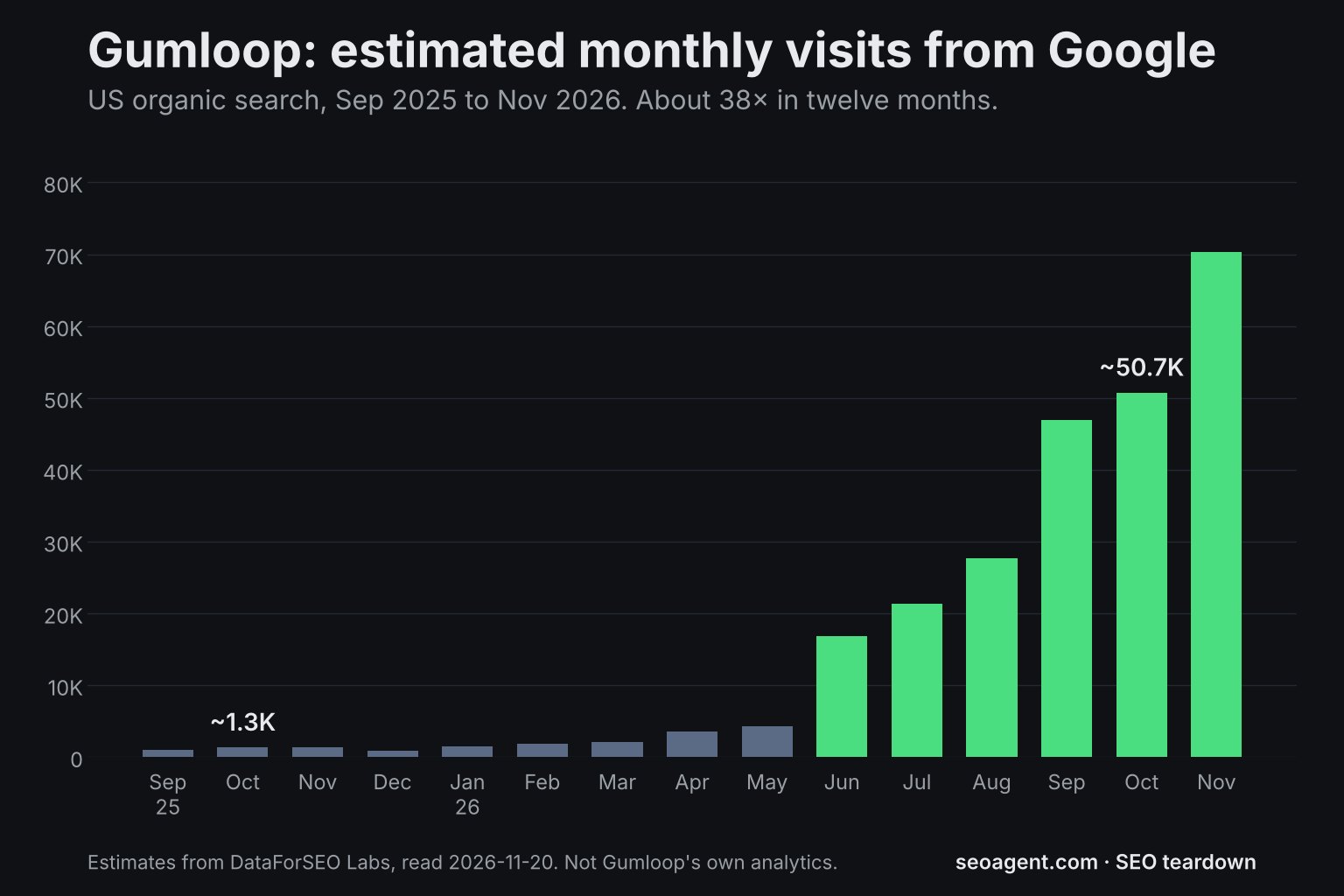
- Gumloop, an AI agent builder, went from about 1,300 to about 50,700 estimated monthly visits from US Google search between October 2025 and October 2026. Every traffic number here is a DataForSEO estimate, not Gumloop's own analytics.
- It ranks for about as many searches as it did a year ago (roughly 2,900 then, 3,200 now). The number of searches where it sits at #1 went from 19 to 986.
- One page, "15 best AI apps I can't live without in 2026", gets about 73% of the estimated traffic. List posts as a group get about 95%.
- The lists share one template: a named author, a "how I chose" section, the full list of names up top, then "Best for" and "Pricing" lines, notes from use and screenshots for every tool.
- You can copy the template and the habit of re-testing it. Watch the concentration: most of the traffic rides on one page holding #1 for a broad search.
Each teardown on this blog picks a public site whose estimated search traffic grew at least 3× in a year and reads what it built. For gumloop.com we used DataForSEO Labs (US Google, English, read on 2026-11-20), SEOAgent's free URL check, and the pages themselves. We have no access to Gumloop's analytics, so treat every visit figure as an estimate that can be off in either direction. The shape of the curve and the split between pages are more reliable than any single number.
The numbers, month by month
| Month | Estimated visits from Google | Searches it ranks for | Searches at #1 |
|---|---|---|---|
| Oct 2025 | ~1,300 | ~2,900 | 19 |
| Jan 2026 | ~1,500 | ~4,800 | 85 |
| Apr 2026 | ~3,600 | ~3,000 | 299 |
| May 2026 | ~4,300 | ~2,900 | 415 |
| Jun 2026 | ~16,900 | ~3,600 | 736 |
| Aug 2026 | ~27,600 | ~3,600 | 1,023 |
| Oct 2026 | ~50,700 | ~3,200 | 986 |
| Nov 2026 (latest reading) | ~70,300 | ~3,000 | 917 |
Source: DataForSEO Labs historical_rank_overview, United States.
The first big step came between May and June 2026, from about 4,300 to about 16,900 estimated visits, and the estimate rose every month after that. The count of searches Gumloop ranks for barely moved over the year. Its positions moved a lot, with searches at #1 rising from 19 to about 1,000.
For a founder, that is the useful part. Gumloop grew mostly by climbing to the top of page one, where most of the clicks go, while the number of searches it shows up for stayed about the same.
Where the visits land
| Page | Estimated visits a month | Searches it ranks for | At #1 |
|---|---|---|---|
| /blog/best-ai-apps | ~35,000 | 916 | 467 |
| /blog/best-ai-workflow-automation-tools | ~2,100 | 142 | 75 |
| /blog/agentic-ai-tools | ~1,700 | 120 | 76 |
| /blog/best-ai-agent-builder | ~1,400 | 28 | 7 |
| Home page | ~1,350 | 76 | 10 |
Source: DataForSEO Labs relevant_pages, United States, read 2026-11-20.
The AI apps page ranks #1 in DataForSEO's US data for "ai apps" (about 49,500 searches a month), "free ai tool" (about 60,500), "ai platforms" (about 22,200) and "best ai apps" (about 18,100). People typing those searches have usually never heard of Gumloop.
Brand searches are a small slice. "gumloop" gets about 9,900 searches a month and sends an estimated 1,100 visits, under 3% of the traffic from the site's top 100 keywords. The growth came from strangers.
What Gumloop built: one template, used about 60 times
Gumloop's sitemap lists 162 blog posts. 58 of them are "best X", "X tools" or "X alternatives" posts, and 34 are alternatives posts ("11 best n8n alternatives to build AI agents in 2026", for example). The five pages that bring the most traffic follow the same template:
- A title with a count, a year and who it is for. "15 best AI apps I can't live without in 2026 (free + paid)". "8 best agentic AI tools I'm using in 2026 (free + paid)".
- One named author. All five carry the same byline, a date and a link to an author page, and their Article structured data names that author as a Person.
- A short definition first. "What is an AI app?" answers the broad search before the list starts.
- A "how I chose" section in the first person. The AI apps page says its author tested over 70 tools and lists the tests: how often he still opened a tool after the first week, output quality, price, how it fits with other tools.
- The whole list as plain names before any detail. A reader who wants only the names gets them without scrolling.
- The same labels on every entry. "Best for" and "Pricing" on each tool, then "How I use it" on the AI apps page and "What I like" on the agent builder and n8n pages. The agent builder and n8n pages also list cons for each tool. The AI apps page carries 58 images, mostly screenshots.
- Gumloop inside its own lists. It is #1 in four of the five lists and #2 in the AI apps list, with a short call to action.
- Many internal links. Each post carries 75 to 85 internal links, navigation included, and 15 to 25 of them point to other blog posts, so a reader on one list finds the next.
- Recent dates. The top pages were last updated in September and October 2026, and the author page already shows a post titled for 2027.
This lines up with what Google asks of review content. Google's guide on how to write reviews asks writers to "provide evidence such as visuals, audio, or other links of your own experience" and to "discuss the benefits and drawbacks of something, based on your own original research." Screenshots, "How I use it" lines and per-tool cons are that evidence, in a form a reader can check.
What carried less
The sitemap also lists about 350 connector pages, one per integration. Programmatic pages like these are often the first SEO project a founder starts, because they are easy to generate from data you already have. On gumloop.com, only one connector page appears among the 40 pages with the most estimated search traffic, with about 20 visits a month. The hand-written lists did the work.
Connector pages can still help people who are already evaluating the product. On this site they brought few strangers from Google.
The URL check
We ran SEOAgent's URL check (the same one behind the free SEO doctor) on gumloop.com on 2026-11-20. It read 8 pages and passed all 12 checks: the home page loads and can be indexed, canonical tags point at the site itself, the content is in the HTML, robots.txt lets Google in, there is Organization structured data and an XML sitemap, http and www redirect to one address, and titles, meta descriptions and H1s are in order. The site runs on Vercel and is built from a code repository.
Clean technical basics don't explain a 38× jump on their own, but they keep the site from getting in the way of the pages that earn the traffic.
What you can copy this week
- Find the broad "best [category]" search your buyers type before they know your name. Search it in a private window. If the top results are lists, Google wants a list for that search.
- Write the list as someone who used every tool. Put a real name on it, write down how you chose, and add a screenshot and a "How I use it" line for each entry.
- Put your own product where an honest reader would put it. State its limits next to everyone else's. A reader who catches a rigged list leaves, and a list that reads as an ad stops getting cited.
- Give the answer first. List every name in one short block before the long sections.
- Write an alternatives post for each tool your buyers compare you with. Gumloop has 34. Start with the two or three names that come up in your sales calls.
- Link the lists to each other so a reader on one finds the next.
- Put a quarterly re-test in your calendar. Re-check prices, drop tools that died, add new ones, and change the year in the title only after the content changed.
What to watch out for
Concentration. About 73% of the estimated traffic lands on one page. If Google reorders the results for "ai apps", most of Gumloop's search traffic moves with it. Sibling lists spread that risk, and Gumloop is building them.
Browsers vs. buyers. Someone searching "free ai tool" may never need an agent builder. Judge a list like this by the signups and demos it starts, not by its visits. No traffic estimate can see that, and we can't see Gumloop's.
Dates that mean something. Google's guidance on helpful, people-first content asks: "Are you changing the date of pages to make them seem fresh when the content has not substantially changed?" A year in the title is a promise that the list was re-tested.
Lists that rank yourself. Gumloop is at or near the top of its own lists. Readers accept that when the reasons are specific and the other entries get a fair hearing. Without that, the format turns into an ad.
Why this takes a strategy that keeps running
The AI apps page won because someone tested the tools, wrote down how, kept the screenshots current and kept the page fresh as the market changed. Next quarter it will need all of that again. A one-off session with an AI can draft a list like this today. It won't notice in March that the page slipped from #1 to #4, that two of the tools shut down, or that the title still says 2026.
SEOAgent does that ongoing part. It installs as a GitHub App, reads your Search Console data, and opens pull requests in your repository with the refreshed list or the next alternatives page. Nothing ships until you approve it.
Before you write your first list, check that Google can read your site: run your URL through the free SEO doctor. It needs no login.
Sources
- DataForSEO Labs, Google, United States, English, read 2026-11-20:
historical_rank_overview(visits and positions by month),relevant_pages(visits by page),ranked_keywords(searches and positions). All visit figures are DataForSEO's estimated traffic. - gumloop.com: the five pages named above, the author page and
sitemap.xml, read 2026-11-20. - SEOAgent's URL check of gumloop.com, 2026-11-20.
- Google Search Central: How To Write Reviews and Creating Helpful, Reliable, People-First Content.
SEOAgent for GitHub
Your first SEO pull request in about 5 minutes.
Connect the repo your site lives in. SEOAgent finds what holds the site back in search and fixes it in pull requests. You review and merge every change.
- ✓14 days free
- ✓No card
- ✓$79/site/month after
- ✓What SEOAgent found, and the plan for your site
- ✓Meta descriptions for 14 pages
- ✓Sitemap and robots.txt
- ✓Organization schema
- 370+sites
- 1,100+articles written
- 3,500+SEO changes made