How Much Is a Backlink Worth? What People Charge, and How to Work Out the Real Value
Link prices are set by the seller’s domain metrics. What a link is worth to you depends on the readers of one page. Here is what the market charges, a by-hand way to value a specific link, and what Google says about paying for one.
On this page
- TL;DR
- What people charge for a backlink
- Why DR-based prices mislead
- How to estimate what one link is worth to you
- What the estimate leaves out
- What Google says about paid links
- When a link isn't worth buying
- Frequently asked questions
- How much does a backlink cost in 2026?
- Is buying backlinks against Google's rules?
- Is a sponsored link still worth paying for?
- What is a link insertion or niche edit?
- How long does a paid link stay up?
TL;DR
- What people charge: Ahrefs bought links in 2018 at an average of $361.44. In 2026, one marketplace's data puts the average guest post at $459 and a link insertion at $225, and a study of 16,625 publishers found a median of $570 for a sponsored article.
- What sets the price: the seller's domain rating (DR), site traffic and niche. None of those measures what one link on one page will send you.
- What a link is worth to you: the readers of that page, times the share who click your link, times what a visitor is worth to you, over the months the page keeps its readers. SEOAgent doubles that for a followed link on Google's first page, as a rough allowance for rankings.
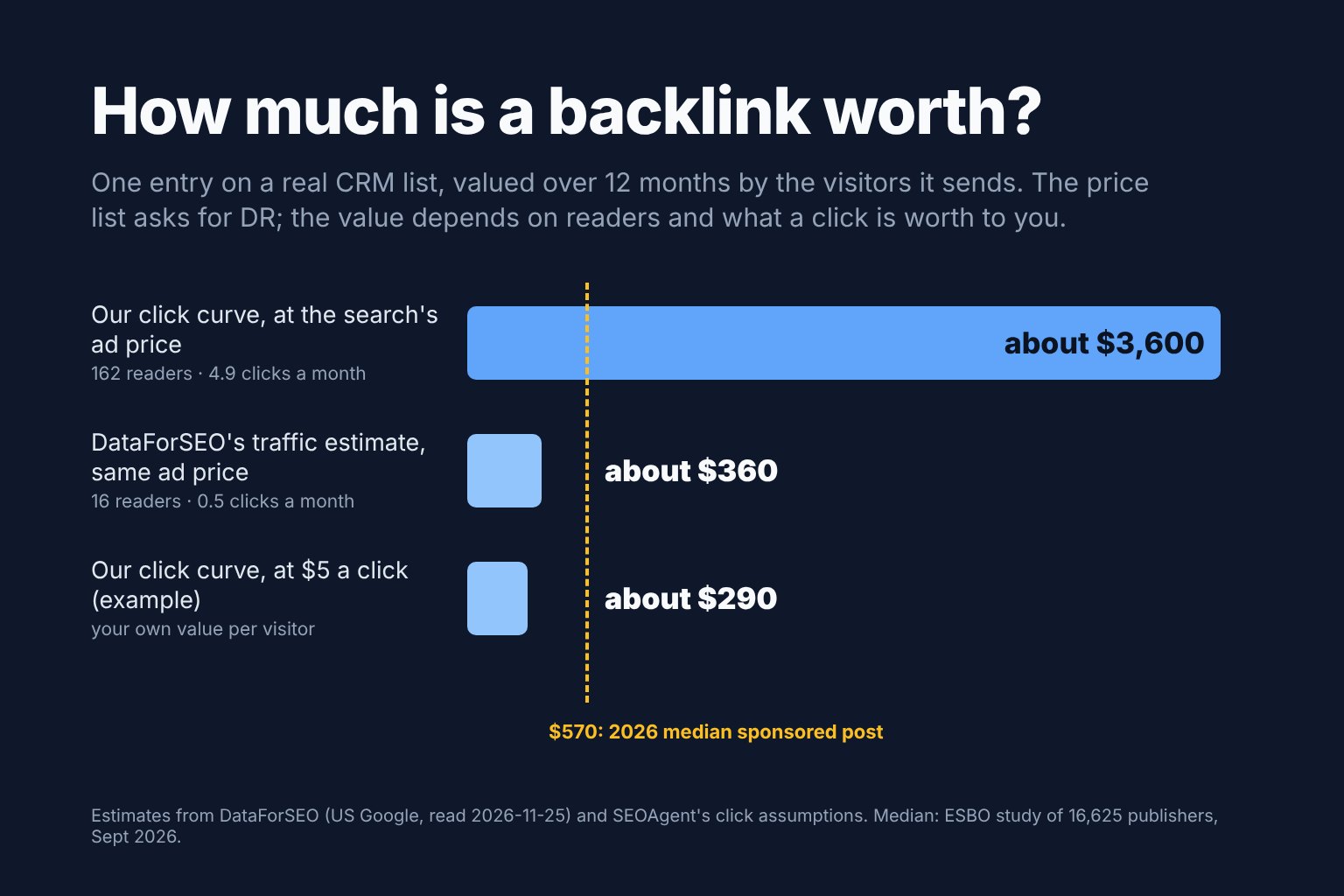
- A real example: on a CRM list that Google's AI Overview cites, the visitors from the same entry come out between about $360 and $3,600 a year, depending on whose traffic estimate you trust.
- What Google allows: paying for a link is fine when the link is marked
rel="sponsored"(ornofollow). Paying for a link so it passes ranking credit is what Google's spam policy calls link spam. Buying followed links is still widespread; if you do it, it's your call and your risk.
Editors and agencies quote prices for links all the time: a "link insertion" into an existing article for one price, a guest post for another, more for a site with a higher DR. If you run a small product, the useful question is narrower than "what's the going rate". It is whether this link, on this page, is worth the price to you.
Below are what the market charges, with sources; why prices keyed to DR mislead; a way to estimate one link's value by hand, which is the same arithmetic SEOAgent uses when an editor quotes a price in reply to its outreach; what Google says about paid links; and when a link isn't worth buying at all.
What people charge for a backlink
The public numbers come from three kinds of sources: tests where someone asked sites for a price, data from marketplaces that sell placements, and agencies' own price pages. All were read on November 25, 2026.
| Source | Year | What they did | What they found |
|---|---|---|---|
| Ahrefs | 2018 | Emailed 450 sites in 9 niches asking to buy a link; 54 sold one | Average $361.44 a link; paid guest posts averaged $77.80 |
| Adsy | Feb 2026 | Its own marketplace inventory, 52,671 sites | Guest post average $459, link insertion average $225; average asking price $929, usually paid $207 |
| ESBO, via Ranktracker | Sept 2026 | Quotes from 16,625 publishers with DR over 30 and 2,000+ monthly visits | Median $570 for a sponsored article, from $355 at DR 30–39 to $1,840 at DR 80+; link insertion median $270 |
| The Website Flip | 2025 | 93,812 listings scraped from six link marketplaces | Median $216.96 a listing |
Agencies that sell guest posts and link insertions publish tiers keyed to the same metrics. On the pages we read, FatJoe lists $72 at DR 10+ up to $456 at DR 60+ (with a holiday discount showing), The Hoth $150 at DA/DR 20+ up to $375 at 50+, and Rhino Rank $60 to $210 by the number of sites linking to the host.
Two things stand out. Asking prices are much higher than what people pay (Adsy's $929 against $207). And in ESBO's data, publishers that require a sponsored label charge more, a median of $1,300 against $430 for the rest. The sites with a real audience price the audience. ESBO's own advice is to "buy placements like media: start with the audience and context, then treat the link as an added benefit."
Why DR-based prices mislead
DR (Ahrefs' Domain Rating) and DA (Moz's Domain Authority) score a whole domain by how many sites link to it and how strong those sites are. Sellers price by them because they're easy to look up. They describe the seller, though, and your link sits on one page of the seller's site.
- A high-DR site can put you on a page nobody reads. The page's own readers decide how many people see your link, and no domain score tells you that.
- Site traffic is not page traffic. A site with 100,000 visits a month can hold your link on a page that gets ten.
- Niche prices reflect other buyers. Finance and crypto links cost more because those buyers' customers are worth more to them, which says nothing about your customers.
- Much of what a DR price pays for is ranking credit. That is the part Google says a paid link must not pass (more below). Ahrefs itself notes that Google's algorithms can ignore "many spammy and paid backlinks", so a link priced high for its DR can pass nothing.
A DR 30 list that ranks third for the search your buyers type can be worth more to you than a DR 80 site that files you under a page with no readers.
How to estimate what one link is worth to you
The method starts from the visitors a link sends you, because that is the part you can check afterwards in your own analytics. Rankings come last, as a separate and rougher step.
You need five numbers, plus a sixth step if the link will be followed. Here they are with a real page: PCMag's list of the best small business CRM software. We use it only to show the arithmetic. We don't know or suggest that it sells entries. The data comes from DataForSEO, US Google, and every traffic figure is an estimate.
1. The search the page is read for, and its monthly searches. Pick the search your buyers would type to find this page. For this page, "best crm for small business" gets about 3,600 searches a month on average (6,600 in September and October 2026).
2. The page's readers from that search. Multiply the searches by the share of searchers who open a result at the page's position. In DataForSEO's September 2026 snapshot the page was #8, and SEOAgent's curve gives 3% of searchers at #8, so about 108 readers a month. SEOAgent adds half again (162) when an AI answer cites the page, on the guess that people read it there too; Google's AI Overview cited this page on November 25.
Be careful with this step. Click curves were built before AI answers. Ahrefs found the average click-through rate for the top result on searches with an AI Overview fell from 7.3% in December 2023 to 1.6% in December 2025, on desktop (Ahrefs, 2026). Pew Research found people clicked a regular result on 8% of Google visits that showed an AI summary, against 15% without one (Pew, 2025). DataForSEO's own traffic model puts this page's visits from that search at about 16 a month, not 108. If a tool gives you a traffic estimate for the page itself, use it.
3. The share of readers who click your link. SEOAgent assumes 3% for an entry in a list and 1% for a link inside an article's text. These are assumptions, not measurements. At 162 readers that is about 4.9 clicks a month; at 16 readers, about half a click.
4. What one click is worth to you. The quick number is the search's cost per click in Google Ads: $62.47 for this search. That is what the biggest advertisers pay, so treat it as a ceiling. Your own number is your visitor-to-customer rate times what a customer is worth. With made-up numbers to show the arithmetic: if one visitor in 50 becomes a customer worth $250 to you, a click is worth $5.
5. The months the page keeps its readers. SEOAgent uses 12. Check the page's history before you trust it. This page was #8 in September and outside the top 19 results on November 25, while the AI Overview still cited it.
6. Rankings, if the link is followed. When the page is on Google's first page and the link will be followed, SEOAgent doubles the total, as a rough allowance for what the link may do for your own rankings. Treat this step as a guess: nobody can measure one link's effect on rankings in advance. It is also the step Google's policy is about (see below). If the link carries rel="sponsored", leave it out.
Multiply the numbers together:
| Readers a month | Clicks to you a month | Value per click | Visitors' worth over 12 months | |
|---|---|---|---|---|
| SEOAgent's curve, AI-cited, at the search's CPC | 162 | 4.9 | $62.47 | about $3,600 |
| DataForSEO's traffic estimate, at the search's CPC | 16 | 0.5 | $62.47 | about $360 |
| SEOAgent's curve, at the made-up $5 a click | 162 | 4.9 | $5 | about $290 |
The visitors from the same entry on the same page are worth anywhere from about $290 to $3,600 a year. Step 6 would double each row for a followed link (about $7,300 at the top). The two inputs that move it most are which traffic estimate you believe and what a click is worth to you. Neither appears on any price list. Compare the result with the price: at the $570 median from the ESBO study, the visitors alone pay for this link only at the top of the range.
Try it with your own numbers
Prefilled with the CRM list example above. Change any number and the estimate updates.
Estimate
- Readers a month
- 162
- Clicks to you a month
- 4.9
- Value of one click
- $62.47
- Value a month
- $303.60
The visitors, over 12 months
$3,643
Worth it at $570. The estimate, $3,643, covers the price.
An estimate, not a promise. The click curve and the share who click an entry are SEOAgent's assumptions, and click rates have fallen where AI answers show.
The same calculator has its own page, for the next time an editor quotes a price: the backlink value calculator.
When an editor answers SEOAgent's outreach with a price, it runs this same sum, recommends accept, counter or decline against a monthly budget the site owner sets, and drafts the answer. The owner decides, edits the answer if they want a different kind of link, and sends it. SEOAgent never pays anyone itself.
What the estimate leaves out
- The page's other searches. This page ranks for 139 searches in DataForSEO's data; the method counts one. That makes it conservative.
- Being named where AI answers read. A list that AI answers cite can get your product named in the answer, even when nobody clicks.
- Your place in the list. The first entry and the ninth don't get the same 3%.
- Risk. The estimate puts no cost on the chance that Google ignores an unlabelled paid link or acts against the site that bought it. Weigh that yourself.
What Google says about paid links
Google's spam policies (updated November 23, 2026) define link spam as "creating links to or from a site primarily for the purpose of manipulating search rankings." The first example is "buying or selling links for ranking purposes," which includes "exchanging money for links, or posts that contain links."
The same page says paid links are allowed when they're labelled:
Google does understand that buying and selling links is a normal part of the economy of the web for advertising and sponsorship purposes. It's not a violation of our policies to have such links as long as they are qualified with a rel="nofollow" or rel="sponsored" attribute value to the tag.
Google's page on qualifying outbound links says to "mark links that are advertisements or paid placements (commonly called paid links) with the sponsored value," and that nofollow "is still an acceptable way to flag them, though sponsored is preferred." On consequences, Search Console's manual actions help says buying links to manipulate rankings "can result in some or all of your site getting a manual action."
In practice, buying followed, unlabelled links is widespread, and many sellers advertise their links as "do-follow". Whether to buy one is your call and your money. If you do, go in knowing that Google's policy is against it, that the ranking part (step 6) is the part Google may ignore, and proceed with caution. If you want to stay inside the policy, ask for rel="sponsored" and value the link by its visitors alone. For the HTML side of these attributes, see our guide to external links.
When a link isn't worth buying
- The page doesn't rank for anything your buyers search. No readers means no clicks, whatever the DR.
- The estimate is below the price, even at the high end. Counter with the number you worked out, or walk away.
- It only pays off through rankings. If the visitors alone don't come close to the price, you are paying for the step-6 guess, which is the part Google may ignore.
- The site sells to everyone. A "write for us" page with a price list, posts on unrelated topics and outbound links in every paragraph point to a site that exists to sell links, and its readers, if any, aren't your buyers.
- You'd pay before the link is live. Pay once the entry is published, and check the link yourself.
- Your own page can't turn a visitor into a customer. Fix the page the link points to first; extra visitors to a weak page are worth little.
- You could earn it instead. Editors of lists often add a product for free when you give them access to test it, a clear one-paragraph description and screenshots. Ask for that before you talk price.
Search Console shows a sample of the links Google has found to your site, which is a free way to see what you already have: see how to check your backlinks in Search Console. For how links fit into the rest of an SEO budget, see how much SEO costs.
Frequently asked questions
How much does a backlink cost in 2026?
Published 2026 data puts a guest post or sponsored article at roughly $200 to $600, and more on the highest-rated sites. Adsy's marketplace averages $459 for a guest post and $225 for a link insertion; ESBO's study of 16,625 publishers found a median of $570 for a sponsored article, rising to $1,840 at DR 80+.
Is buying backlinks against Google's rules?
Buying links to pass ranking credit is. Google's spam policy lists "buying or selling links for ranking purposes" as link spam. Paying for a placement is allowed when the link carries rel="sponsored" or rel="nofollow". Buying followed links is still common; if you do it, you take that risk on yourself.
Is a sponsored link still worth paying for?
It can be, for the visitors it sends. Estimate it from the page's readers, the share who click your link, what a visitor is worth to you and how long the page keeps its readers. If that number is below the price, it isn't worth buying.
What is a link insertion or niche edit?
A link added to an article that is already published, instead of a new guest post. Adsy's 2026 data puts the average at $225, and ESBO's study puts the median at $270.
How long does a paid link stay up?
It depends on the seller. Some agency pages promise links for good; most pages we read state no term. Check that the link is still there every few months, and value a link only for the months you expect the page to keep its readers.
Before you answer the next email that quotes a price, look up the page's main search, its position and its traffic estimate, then multiply the five numbers above.
SEOAgent for GitHub
Your first SEO pull request in about 5 minutes.
Connect the repo your site lives in. SEOAgent finds what holds the site back in search and fixes it in pull requests. You review and merge every change.
- ✓14 days free
- ✓No card
- ✓$79/site/month after
- ✓What SEOAgent found, and the plan for your site
- ✓Meta descriptions for 14 pages
- ✓Sitemap and robots.txt
- ✓Organization schema
- 370+sites
- 1,100+articles written
- 3,500+SEO changes made