How to Get Cited by Perplexity
Perplexity is a search-first answer engine that cites heavily. Here's the practical, step-by-step way to become one of those sources — and the mistakes that keep you out.

On this page
- How Perplexity surfaces and cites sources
- How to get cited by Perplexity, step by step
- 1. Let Perplexity's crawlers in
- 2. Write answer-first content
- 3. Add structured data and FAQs
- 4. Become a recognized source and earn mentions
- 5. Keep content fresh
- 6. Make factual claims clear and checkable
- Perplexity vs ChatGPT: how citations differ
- Common mistakes
- Frequently asked questions
- How is getting cited by Perplexity different from ranking on Google?
- Can I pay to get cited by Perplexity?
- How do I check whether Perplexity can read my site?
- Does optimizing for Perplexity help with other AI engines?
- Do I need a separate tool for this, or is it just SEO?
- Conclusion
TL;DR — To get cited by Perplexity, make your pages easy to crawl and easy to trust right now. Let Perplexity's crawlers (PerplexityBot for indexing, Perplexity-User for real-time fetches) through your robots.txt and firewall, lead with a direct answer, add structured data and FAQs, keep pages fresh, and earn mentions on sources Perplexity already reads. This is AI search optimization tuned for the engine that cites the most aggressively.
How Perplexity surfaces and cites sources
Perplexity is a search-first answer engine. Ask it a question and it runs a live search, reads a handful of pages, and writes a synthesized answer with numbered inline citations linking back to the sources. Unlike a chatbot that occasionally adds links, citation is the whole product — nearly every claim is footnoted. That makes the target concrete: be one of the numbered sources.
Two things decide whether you make the cut: can Perplexity reach your page, and does it trust what's on it right now.
Reachability comes down to crawlers. Perplexity uses two distinct user agents that do different jobs:
| Crawler | What it does |
|---|---|
PerplexityBot |
Crawls and indexes pages so they can surface in Perplexity results |
Perplexity-User |
Fetches a page in real time when a user's question points to it |
If either is blocked — in your robots.txt, by a firewall rule, or by a bot-management product like Cloudflare's AI bot blocking — your page is effectively invisible. PerplexityBot controls whether you show up in the index; Perplexity-User controls whether a page can be pulled into a live answer. Blocking isn't a ranking penalty, it's an on/off switch. Claude splits the same jobs across three agents (ClaudeBot, Claude-SearchBot, Claude-User); our guide to AI visibility optimization tools covers which ones to allow.
Trust is the harder half. Because Perplexity answers from a fresh search rather than from memory, it leans hard on pages that answer the question directly, are clearly structured, and look current and corroborated. The bar isn't keyword density — it's whether a sentence on your page can be lifted, footnoted, and defended.
How to get cited by Perplexity, step by step
1. Let Perplexity's crawlers in
Start here, because nothing else matters if you're blocked. Check your robots.txt for Disallow rules targeting Perplexity's user agents, and confirm your CDN or firewall isn't dropping them. A permissive baseline looks like this:
User-agent: PerplexityBot
Allow: /

User-agent: Perplexity-User
Allow: /
Allow both. PerplexityBot gets you into the index; Perplexity-User lets a page be fetched live when a question lands on it. Blocking one while allowing the other leaves a gap, and the gap is exactly where citations come from.
2. Write answer-first content
Lead every page with the answer. Put a direct, self-contained response to the core question in the first paragraph — ideally something Perplexity could quote verbatim and footnote. Then expand. The inverted-pyramid structure that works for news works for AI extraction: conclusion first, supporting detail after.
Use the actual question as a heading where it fits, and keep paragraphs tight. Perplexity extracts cleanly from clear sentences, short paragraphs, and scannable lists far more reliably than from long, hedged prose. The same answer-first discipline that helps you rank on ChatGPT works here.
3. Add structured data and FAQs
Group the predictable follow-up questions into an FAQ section with real, specific answers — not filler. This gives Perplexity discrete, quotable units that map directly to how people phrase questions in the search box.
Back it with structured data. FAQPage, Article, and HowTo JSON-LD make the structure of your page machine-readable, so the engine can tell what each section is for. Schema isn't a magic ranking lever, but it removes ambiguity — and ambiguity is what gets pages skipped.
4. Become a recognized source and earn mentions
This is the part you can't fake. Perplexity corroborates claims across the results it pulls, so being referenced on sources it already reads — reputable publications, well-moderated communities, established directories — raises the odds it treats your page as credible. Earn mentions the durable way: genuinely useful content, real relationships, and being quotable. Buying links or spamming forums does the opposite, and an engine built on cross-checking is unusually good at noticing.
5. Keep content fresh
Freshness matters more for Perplexity than for most engines. Because it answers from a live search rather than static memory, recent and well-maintained pages have a real edge, especially on time-sensitive topics. Keep important pages updated, set an accurate dateModified in your Article schema, and make sure the visible content reflects real edits — not a bumped date over stale text. A page untouched for two years competes poorly against one updated this quarter.
6. Make factual claims clear and checkable
Perplexity favors content that reads like it can be verified. State facts plainly, attribute numbers and quotes to their origin, and avoid vague hedging that gives the engine nothing solid to cite. A clean sentence with a concrete claim and a clear source is exactly the kind of unit Perplexity likes to footnote.
Perplexity vs ChatGPT: how citations differ
Both are answer engines, but they cite differently, and the differences change what you optimize for.
| Perplexity | ChatGPT | |
|---|---|---|
| Citation habit | Footnotes nearly every claim | Cites when search is invoked |
| Default mode | Always search-first | Search when the question needs it |
| Freshness weight | Heavy — favors current pages | Moderate — leans fresh for time-sensitive queries |
| What wins | Clear, checkable, recent sources | Trusted, corroborated, well-structured sources |
The practical takeaway: Perplexity cites more aggressively and rewards freshness more, so maintenance and clean, checkable claims pay off faster there. The fundamentals overlap heavily with broader answer engine optimization — you optimize one set of pages for both, not two separate playbooks. The same passage structure wins Google's answer box, which is the job a featured snippet optimization tool should be doing.
Common mistakes
- Blocking the crawlers by accident. A blanket
Disallowor an aggressive bot-management setting can wall offPerplexityBotorPerplexity-Userwithout you noticing. Check first. - Burying the answer. A 400-word intro before you say anything useful gives the engine nothing clean to footnote.
- Letting pages go stale. Perplexity's freshness bias punishes neglect harder than most engines. An outdated page loses to a maintained competitor.
- Vague, unattributable claims. "Studies show" with no specifics is hard to cite. Concrete, sourced statements get footnoted.
- Publishing thin, isolated pages with no surrounding depth, then wondering why a more thorough competitor gets cited instead.
Frequently asked questions
How is getting cited by Perplexity different from ranking on Google?
Google returns a ranked list of links; Perplexity writes one answer and footnotes the sources behind it. The signals overlap — crawlability, structure, authority, freshness — but Perplexity weights direct, checkable answers and recency more than raw backlink counts. You can rank on Google and still miss Perplexity citations if your page buries the answer or hasn't been touched in years.
Can I pay to get cited by Perplexity?
No. There's no paid placement in Perplexity's organic citations. Visibility comes from being crawlable, current, trustworthy, and genuinely useful — the same earned-not-bought logic as classic SEO.
How do I check whether Perplexity can read my site?
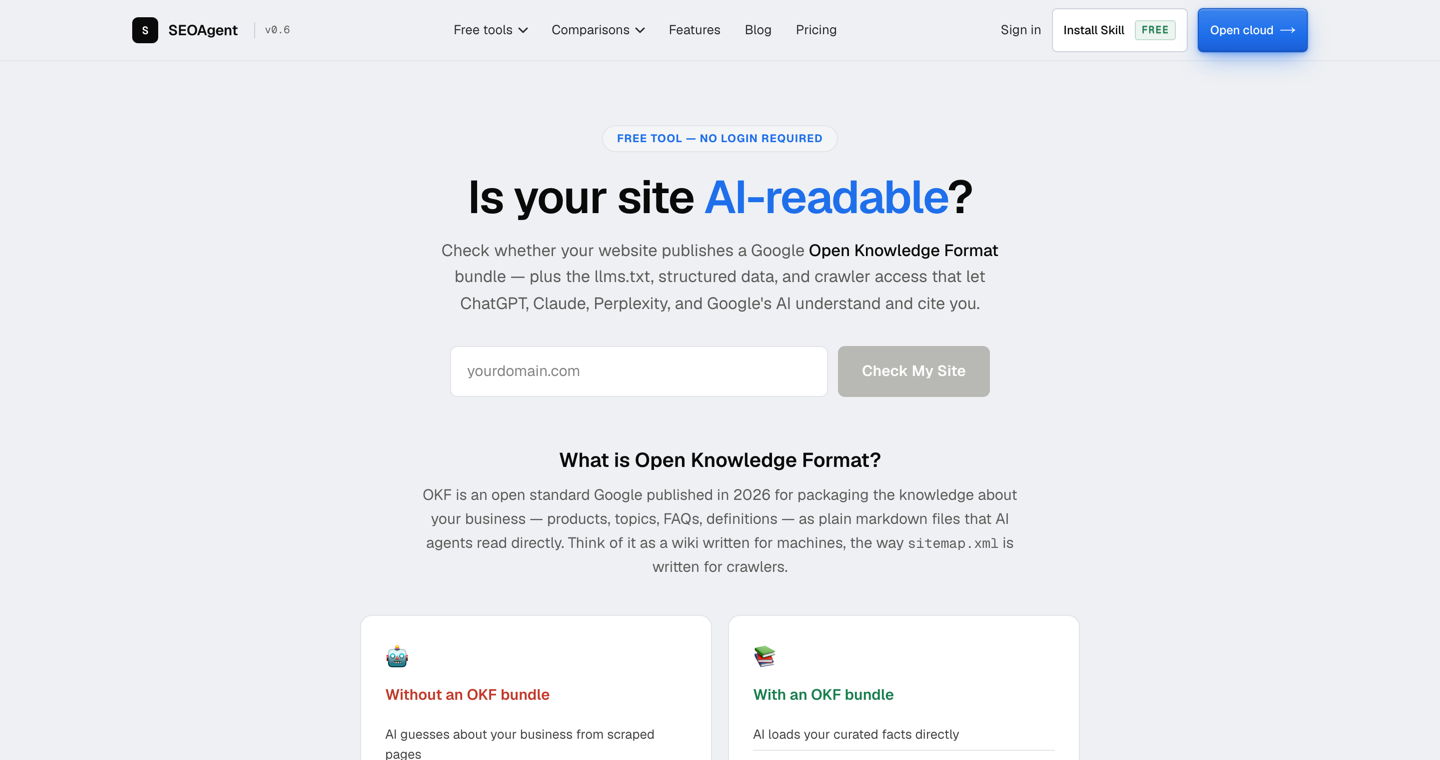
Confirm neither PerplexityBot nor Perplexity-User is blocked in robots.txt or by your firewall, then verify your pages return clean, server-rendered HTML rather than content that only appears after JavaScript runs. You can check how AI-ready a page looks with the OKF checker. To record whether Perplexity actually cites the page once access works, an AI search visibility checker covers the per-engine test set and the fields to log.
Does optimizing for Perplexity help with other AI engines?
Yes, mostly. Answer-first writing, structured data, freshness, and corroboration help across Perplexity, ChatGPT, and AI Overviews alike. Perplexity just rewards freshness and clean citable claims a bit harder, so getting it right there tends to lift your visibility everywhere else too.
Do I need a separate tool for this, or is it just SEO?
It's mostly disciplined SEO with an AI emphasis: crawl access, answer-first writing, schema, freshness, and checkable claims. Tooling helps you stay consistent. SEOAgent ships an Open Knowledge Format bundle and a citations checker to see how your content reads to assistants — useful, but the fundamentals above matter more than any single tool.
Conclusion
Getting cited by Perplexity isn't a trick — it's making your best content reachable, current, and quotable, then keeping it that way. Let PerplexityBot and Perplexity-User in, answer the question in the first line, structure it with FAQs and schema, keep it fresh, and earn corroboration from sources Perplexity already reads. That's AI search optimization in practice — and if you build your site in a codebase, SEOAgent can help you keep those fundamentals in place as you ship.
Put SEO on autopilot in your own editor
SEOAgent runs as a free skill inside Claude Code, Cursor, and Codex — on the model you already pay for. Audit, plan, and write SEO content right in your repo, with every change reviewed before it ships. No second AI subscription.
What do you use to work on your site?
Pick one above and we take you to the right setup.