SEO Consulting: What a Consultant Does, and an Agent That Ships the Work
An SEO consultant tells you what to change; someone on your team still has to change it. What consulting includes, how it is priced, how to hire well, and when an agent that opens the pull requests is the better buy.
On this page
- What does an SEO consultant do?
- How SEO consultants charge
- SEO consultant vs SEO agency vs SEOAgent
- What SEOAgent does in a consultant's place
- When a human SEO consultant is the better hire
- How to hire an SEO consultant
- Frequently asked questions
- What is search engine optimization consulting?
- How much does an SEO consultant cost?
- Can an SEO agent replace an SEO consultant?
- Can I use SEOAgent and an SEO consultant together?
- References
Search engine optimization consulting means paying an expert to work out why your site is not getting search traffic and what to change. A good consultant hands you an audit, a keyword plan and a ranked list of fixes. Most engagements stop there: someone on your team still has to edit the pages, the templates and the sitemap, and that is where many SEO plans stall.
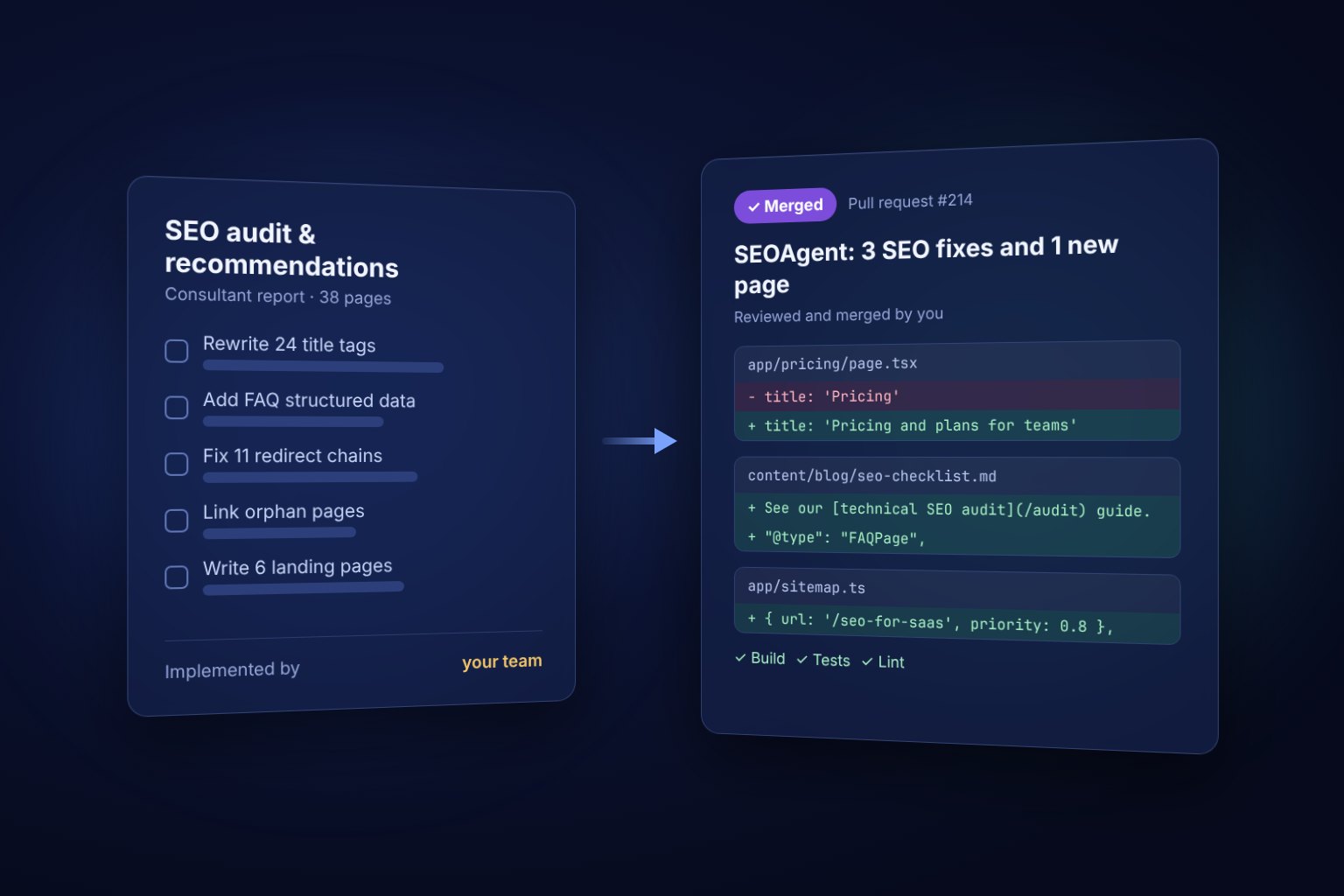
SEOAgent does the consultant's job and the implementation. It audits your site, reads your Google Search Console data, plans the week's work, and opens a pull request with the changes already made, for $79 per site per month. You review the diff and merge it. This page covers what each option gets you, how consultants charge, how to hire one well, and when a person is the better hire.
We run it on this site. On November 24, 2026, SEOAgent opened the pull request that added our guide on whether AI will replace Google to this blog, with links to it from three related posts, and we merged it. That loop, from a search opportunity to a reviewed change in the repository, is what the rest of this page compares against a consulting engagement.
What does an SEO consultant do?
An SEO consultant looks at your site from the outside, the way Google and your competitors see it, and tells you what to fix first. The work usually covers:
- A technical audit. Can Google crawl and index every page that matters? Broken links, redirect chains, duplicate pages, missing canonical tags, slow templates and structured data errors.
- Keyword and competitor research. Which searches your buyers make, which of them you can realistically win, and which competitor pages hold the top spots today.
- On-page recommendations. Titles, meta descriptions, headings and the sections a page is missing compared with the pages that outrank it.
- A content plan. Which page should own each search, which new pages to write, and which old ones to merge or retire so they stop competing with each other.
- Links. Internal links between your own pages, and advice on earning links from other sites.
- Reporting. Search Console and analytics read back to you: impressions, clicks, positions, and whether last month's changes moved them.
- Training. Teaching your writers and developers enough SEO to keep the site healthy after the engagement ends.
The deliverable is usually a document or a slide deck, plus calls to walk through it. Implementation is either a separate line item or your team's job.
How SEO consultants charge
Consultants price SEO consulting in three common ways:
- Hourly, for reviews, advice calls and training.
- Per project, for a defined piece of work such as a technical audit, a site migration plan or a keyword map.
- Monthly retainer, for ongoing strategy, reporting and review.
Rates vary widely with the consultant's experience, your market and the size of the site, so compare scopes rather than hourly numbers. The cost a consulting quote rarely shows is implementation: every recommendation becomes hours of developer or writer time on your side. Our guide to what SEO actually costs breaks the full bill down by research, content, implementation and measurement.
SEO consultant vs SEO agency vs SEOAgent
| SEO consultant | SEO agency | SEOAgent | |
|---|---|---|---|
| What you get | Audit, plan and advice | Strategy and some or all of the execution | Audit, a weekly plan, and the changes made in your repository |
| Who changes the site | Your team | The agency, your team, or both | SEOAgent opens a pull request; you review and merge |
| How you pay | Hourly, per project or a retainer | Monthly retainer | $79 per site per month, 14-day free trial with no card |
| When work starts | After the audit is delivered | After onboarding | The next weekday run after you connect the repository |
| Best for | An expert review or a hard one-off problem | Buying outside capacity across channels | Sites whose code lives in a GitHub repository |
What SEOAgent does in a consultant's place
SEOAgent is an SEO agent: software that does the work a consultant recommends, under your review. Connected to your site's GitHub repository, it works in a weekly loop:
- Audits the site. It crawls your pages and checks what Google receives: indexing, titles and descriptions, canonical tags, structured data, internal links and the sitemap.
- Reads your Search Console data. It finds the searches where you already show up on page two, the pages losing clicks, and the gaps where a competitor ranks and you have no page.
- Plans the week. Each week it decides what is worth doing next: a new landing page, a rewrite of a page that slipped, a set of technical fixes.
- Makes the changes. On weekdays it edits the real files in your repository (metadata, structured data, internal links, new pages and articles written in your site's own format) and opens a pull request.
- Waits for you. Nothing goes live until you merge. Ask for changes from the dashboard or in Slack, and it revises the work.
The judgment calls are still a conversation. Every plan, the trial included, comes with unlimited 20-minute calls with Alec, the founder, for the decisions software should not make alone: which market to go after, whether to merge two product pages, how to read a traffic drop.
If you would rather keep the work inside your own coding agent, the free SEOAgent Skill runs the same audits and writes the same changes in Claude Code, Cursor or Codex on your own keys. The SEO agent guide explains how agents differ from SEO tools and agencies in more depth.
When a human SEO consultant is the better hire
An agent is not the answer to every SEO problem. Hire a person when:
- You are migrating a large site. Moving domains or platforms with thousands of URLs involves redirect maps, launch timing and stakeholders across teams. A consultant who has done it before is worth the fee.
- Traffic collapsed and nobody knows why. A manual action from Google or a broad drop after an algorithm update calls for someone who has diagnosed many of them, though SEOAgent can rule out the common technical causes first.
- The strategy depends on business decisions. Which markets to enter, how to position against a dominant competitor, whether to build a free tool: those need someone in the room who knows your business.
- You need links from other sites. Earning coverage and links is relationship work: pitching journalists, partnerships, guest research.
- Nobody can change the site. If your pages live somewhere neither you nor an agent can edit, advice is all anyone can sell you, and a consultant can at least brief whoever controls the site.
Plenty of teams use both: a consultant sets the direction once a quarter, and the agent does the weekly work between reviews.
How to hire an SEO consultant
Google's own guide, Do you need an SEO?, suggests interviewing a consultant before you hire one. The questions worth asking:
- Can I see examples of your past work? Ask for a sample audit and a before-and-after from a site like yours.
- What exactly will you change, and how will I see it? A good consultant shares every change and the reason behind it.
- How will you measure success, and over what timeframe? Expect Search Console metrics and a horizon of months, not days.
- Do you follow Google's guidelines? Steer clear of anyone who guarantees a number one ranking, will not explain their methods, or buys links. Google warns that no one can guarantee a top ranking.
- Who implements the recommendations? If the answer is your team, budget their hours before you sign.
Ask for four artifacts before you approve the first invoice: a technical audit, a map of which page owns which search, an implementation plan with owners, and a reporting schedule. Those are the same four things SEOAgent produces each week, which makes them a fair way to compare the two.
Frequently asked questions
What is search engine optimization consulting?
It is paid expert advice on improving how your site ranks in search: an audit of what holds it back, research into what your buyers search for, and a prioritized plan of changes. The consultant advises; making the changes is usually up to you.
How much does an SEO consultant cost?
Consultants charge by the hour, by project or by monthly retainer, and rates depend on experience, market and scope. Add the internal cost of implementing their advice. SEOAgent charges a flat $79 per site per month and makes the changes itself.
Can an SEO agent replace an SEO consultant?
For the recurring work of audits, fixes, new pages and reporting, yes, and it also implements the work. For one-off expert calls such as a large migration, a penalty recovery or a positioning decision, a person is still the better choice.
Can I use SEOAgent and an SEO consultant together?
Yes. Give the consultant read access to the pull requests and the dashboard: they set direction, SEOAgent ships the weekly work, and every change is a diff anyone on the team can review.
References
- Do you need an SEO? (Google Search Central)
- SEO Starter Guide (Google Search Central)
SEOAgent for GitHub
Your first SEO pull request in about 5 minutes.
Connect the repo your site lives in. SEOAgent finds what holds the site back in search and fixes it in pull requests. You review and merge every change.
- ✓14 days free
- ✓No card
- ✓$79/site/month after
- ✓What SEOAgent found, and the plan for your site
- ✓Meta descriptions for 14 pages
- ✓Sitemap and robots.txt
- ✓Organization schema
- 370+sites
- 1,100+articles written
- 3,500+SEO changes made