What Is an SEO Landing Page? How to Build One That Ranks
An SEO landing page targets one search query, answers it better than the pages already ranking, and gives the reader one next step. Here is what it needs, how it differs from a paid landing page, and how to build one.
On this page
- SEO landing page vs PPC landing page
- What an SEO landing page needs
- Types of SEO landing pages, with examples
- How to create an SEO landing page
- Common mistakes
- Frequently asked questions
- Is a landing page good for SEO?
- How long should an SEO landing page be?
- Should an SEO landing page have navigation?
- What is the difference between an SEO landing page and a blog post?
- References
An SEO landing page is a page built to rank in organic search for one specific query and turn the visitor who arrives from that search into a signup, lead or sale. It is indexable, targets a single search intent, carries enough content to beat the pages already ranking, and ends in one clear next step.
The difference from any other landing page is where the traffic comes from. A paid landing page receives visitors you bought; an SEO landing page has to earn its visitors by being the best answer Google can find for its query.
SEO landing page vs PPC landing page
The two share a goal and almost nothing else.
| SEO landing page | PPC landing page | |
|---|---|---|
| Traffic source | Organic search | Paid ads |
| Indexed | Yes, it must be | Often noindex to avoid duplicates |
| Navigation | Normal site header and links | Usually stripped to keep focus |
| Length | Long enough to answer the query fully | As short as converts |
| Lifespan | Years, improved over time | The length of the campaign |
| Variants | One URL per query | Many copies for A/B tests |
The practical consequence: never reuse a PPC page as your SEO page. Its noindex, missing navigation and thin copy are deliberate choices for paid traffic and each one works against ranking.
What an SEO landing page needs
One query, one page. Pick the query first and build the page around it. Two pages aimed at the same query split the clicks and links between them and often both rank worse than one would. Before building, search your own site for the term; if an existing page already targets it, improve that page instead.
Intent that matches the results. Search the query and look at what ranks. If the top results are comparison tables, a feature page will not displace them. If they are tools, a 2,000-word essay will not either. Your page should be the same kind of page as the winners, done better.
The query in the places Google reads. Put the primary keyword, or a close form of it, in the title tag and meta description, the H1, and a short, readable slug. Then write for the reader; repeating the phrase beyond that adds nothing.
Proof, not adjectives. Real screenshots of the product, real numbers, named customers if you have them, and a direct answer to the question the searcher typed. A visitor from search has not seen your ad or your homepage; the page has to establish credibility on its own.
One call to action. Pick the single next step that fits the intent: start a trial, try a free tool, book a demo. Repeat it after the main sections, but do not offer five different ones.
Internal links in both directions. Link from the landing page to the related guides that support it, and link to the landing page from those guides. A page nothing links to is hard for crawlers to find and gets little of the site's authority.
Types of SEO landing pages, with examples
Most SaaS sites end up with the same five shapes. Each one answers a different kind of query.
| Type | Query it targets | Example on this site |
|---|---|---|
| Comparison | "X vs Y", "X alternative" | SEOAgent vs Surfer SEO |
| Industry or audience | "SEO for SaaS", "tool for agencies" | SEO for SaaS |
| Integration or platform | "SEO for Claude Code" | SEOAgent for Claude Code |
| Free tool | "mobile usability test" | Mobile-friendly test |
| Feature | "keyword research tool" | Keyword research |
Comparison pages convert well because the searcher is already choosing. Free tool pages earn links because people share tools. Industry pages are the easiest to write badly: swapping the industry name into the same template produces thin near-duplicates, which Google treats as low-value.
How to create an SEO landing page
- Choose the query from data. Use Search Console for terms you already appear for on page two, or keyword research for terms with real volume and a difficulty your site can compete at. Write down the one query the page is for.
- Check you do not already have it. Search the repo and the sitemap for the term. A second page on a query an existing page targets is the most common way to waste a landing page.
- Read the top five results. Note the format, the headings they share, and the question none of them answers well. That gap is your angle.
- Write the page. Direct answer or value proposition first, proof next, then the sections the top results cover, then your gap, then the call to action. Add a short FAQ if the results show "People also ask" questions.
- Set the tags and the URL. Unique title, description, canonical, a slug that reads as the query, and Open Graph tags for sharing.
- Link it in. Add links from at least two related pages and put it in the sitemap.
- Watch it for eight weeks. Track impressions and position for the query in Search Console. A page sitting at positions 8 to 20 usually needs more depth on the questions the query implies, not a new title.
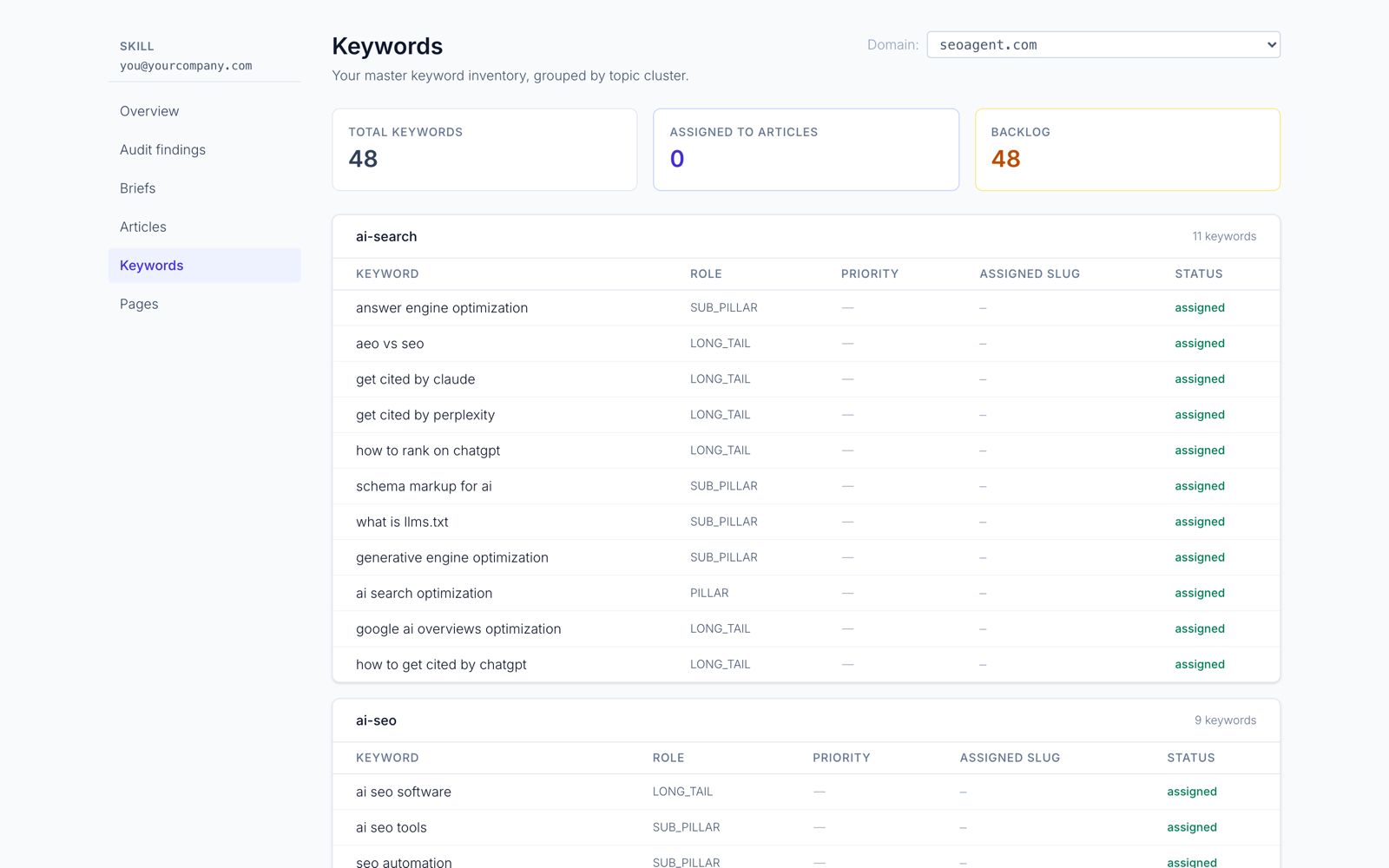
SEOAgent does steps 1 and 2 for you. Its keyword engine flags low-difficulty queries no page on your site covers yet, checks them against your existing pages so it does not propose a page that would compete with one you have, and queues the landing page for your coding agent to write into the repo. You review the page in a pull request like any other change. The keyword research feature shows how the queries are picked.
Common mistakes
- Leaving
noindexon after launch. Staging and template defaults often carry it. Check the live HTML on launch day. - Building pages on queries nobody types. A page for a phrase with no search volume can still be a good sales page, but it is not an SEO landing page.
- Gating the content. If the answer sits behind a form, Google sees the form, not the answer.
- Launching and leaving it. Pages that rank are usually revised several times as Search Console shows which questions searchers bring to them.
Frequently asked questions
Is a landing page good for SEO?
It can be, if it is indexable, targets one query with real search volume, and answers that query fully. A typical conversion landing page with no navigation, little text and a noindex tag is built for paid traffic and will not rank.
How long should an SEO landing page be?
As long as the query needs. Look at the pages ranking now: if they run 1,500 words with a comparison table, a 300-word page will not compete. If they are short tool pages, a long essay is the wrong format.
Should an SEO landing page have navigation?
Yes. Keep the normal site header and footer. Navigation lets crawlers and readers reach the rest of the site and lets the page receive authority through internal links. Stripping navigation is a PPC tactic.
What is the difference between an SEO landing page and a blog post?
Intent. A blog post answers an informational question and earns trust; an SEO landing page targets a query with commercial intent and asks for an action. The two should link to each other: this post, for example, is a guide, and the comparison and tool pages it links to are the landing pages.
References
Put SEO on autopilot in your own editor
SEOAgent runs as a free skill inside Claude Code, Cursor, and Codex — on the model you already pay for. Audit, plan, and write SEO content right in your repo, with every change reviewed before it ships. No second AI subscription.
What do you use to work on your site?
Pick one above and we take you to the right setup.